| The EU Language Regime: Lingual and Translational Problems. (Emily van Someren) |
| home | list theses | contence | previous | next |
Introduction
1.1 The EU language regime
The year 2004 was an important year for the European Union, the year in which
ten new Member States were welcomed into the Union. Over the years, the European
Union has developed greatly, starting out as the European Coal and Steel
Community with six Member States (Belgium, Germany, France, Italy, Luxembourg
and the Netherlands) in 1951, which became the European Economic Community in
1957. The six became nine in 1973 when Denmark, Ireland and the United Kingdom
joined the union, growing to 15 by 1995 with the addition of Greece, Spain,
Portugal, Austria, Finland and Sweden. On the EU portal site (Europa:
Gateway to the European Union) the following is said about the
enlargement of the European Union:
“The European Union (as it had become by then) had created a single market and a
single currency and had expanded its economic and social agenda to foreign and
security policy as well.
The latest enlargement, from 15 to 25, is the biggest in Union history. It has most of its roots in the collapse of communism, symbolised in the fall of the Berlin Wall in 1989, which offered an unexpected and unprecedented opportunity to extend European integration into central and eastern Europe. One of the Union’s first post-enlargement priorities is to raise the newcomers’ living standards, which are all below the EU average.The ten newcomers, Cyprus, the Czech Republic, Estonia, Hungary, Latvia, Lithuania, Malta, Poland, Slovakia and Slovenia, joined formally on 1 May 2004, the culmination of a long process of preparation and negotiation.
Before they joined, the new members had to adopt the so-called acquis communautaire[1], which meant applying 80,000 pages of EU law, making their bureaucratic and administrative structures more efficient, strengthening judicial systems and tightening security at their eastern borders. These now become the external borders of the 25-nation Union. Secure external frontiers are a necessary precondition for maintaining open internal frontiers within the EU. The Union is providing considerable assistance, both material and in terms of technical support and advice, to bring border controls up to EU standards.
Bulgaria and Romania will join the Union in 2007, providing they meet the required standards of readiness in time. The EU is providing maximum support in this process.Two other candidate countries, Turkey and Croatia, are waiting to open their membership negotiations. Croatia’s negotiations will begin in 2005. Turkey’s will too, provided the outcome of the EU’s ongoing review of whether Turkey meets the political criteria for membership, in terms of human rights, the rule of law and the protection of minorities, is positive. An application for membership, submitted by the former Yugoslav Republic of Macedonia in March 2004, is being examined by the European Commission[2] which will decide whether it is ready to begin entry negotiations”.
The EU
language regime distinguishes itself by carrying out a principle of equal
recognition of official languages[3]
of the Member States, which entails that all Member State languages should be
treated as working languages. This principle
”was laid down in the Treaty of Rome in 1957 and has never been changed in
principle, except for special regulations on Letzeburgisch and Irish” (Leitner,
2003).
This regime has given raise to a number of reactions, especially in the daily
press, with respect to the influence of the regime on its translation and
interpretation services.
The following pages contain a selection of news articles that discuss these
issues.
One EU currency, one EU language
31 July 1997
Written by Rik Monard
Translated by Emily van Someren
Source: De Standaard, Belgium
If we maintain all Member State languages as working languages, Rik Monard claims, we do not end up with one Europe, but with the Tower of Babel.
With the enlargement of the European Union the choice for one European language
becomes vital. It is not feasible to proceed with every language of every Member
State: this would bring chaos to the functioning of the European institutions as
it did to the construction of the Tower of Babel.
One could argue that the introduction of a uniform language is as important as
the recognition of a uniform currency. The introduction of one EU language and
one EU currency will put 19th century state nationalism, that has
brought such disaster over our old continent, out of action in Europe.
But which EU language? Geert Lernout[4]
writes: “The English language does not want to become an international language,
it already is” (De Standaard, 17 July 1997). English indeed seems to be the
obvious choice, at first sight at least.
I agreed, and I presume that most Europeans, who are confronted with this
problem for the first time, would react in the same way. But is it really the
best choice?
This problem is too important to leave it up to ‘day-to-day politics’ or even
our ‘statesmen’, who are mostly – alas! – trapped, sometimes with all their
belongings, in obsolete structures. Here is offered a deliberation, as broad as
possible and especially thoroughly democratic, coupled with the necessary
education of the public; here is indicated an idealistic approach.
Do not remonstrate, dear reader, and wave aside my argument as an idle daydream.
‘Les idées mènent le monde.’
I wonder if we shouldn’t opt for a supranational language: this seems to me a
fairer, more righteous and less complicated solution, for everyone. There are
already complaints about the degradation of national languages because of the
supremacy of the English language. With a working language that has been devised
for international communication, this will most probably not be the case.
Shouldn’t we seriously consider to opt for Esperanto, which is logically
composed of, for instance, Germanic, Latin and Slavic elements, and which has
proven itself as an easily learnable language and an excellent instrument for
international contacts?
The fact that Esperanto has not yet had its major breakthrough can be attributed
to the language imperialism of the larger languages, the aftermath of the
previously mentioned, but in future Europe no longer relevant state nationalism.
An additional advantage is that the introduction of one EU language will put a
stop to local frictions on the field of language in border regions. The one EU
language will not wipe national languages off the map, on the contrary: they
will be less threatened than they are nowadays in some well-known border cases.
The multiplicity of national languages in Europe is a cultural asset, of which
we can be very proud. Let all Europeans cherish and love their mother tongue.
Let every nation be governed on municipal and provincial level in their own
language.
But every citizen of the European Union will be bilingual, unless he does not
have to or want to go further than its own church, and speak his own mother
tongue and the EU language. Other bi- or multilingualism is not relevant. […]
Political leaders should not get away from this problem with compromises: there
is one EU language; not two or three, or an exception here and there. Every
European, Polish or German, Hungarian of French, British or Basque, Walloon or
Flemish has to keep himself to the agreed EU language in all European organs,
whether that language is Esperanto – which I hope – or a different language, if
necessary.
(The author is a former executive of a multinational and speaks five languages,
but he is not an ‘Esperantist’.)
(Translation from
“Na één
Euromunt, één Eurotaal.”)
New Member States face urgent translation deadline
8 March 2004
Written by Honor Mahony
Source :
www.euobserver.com
The new Member States are facing a huge translation problem as about half of them have failed to translate the EU's 85,000-page rulebook into their national languages, writes the Financial Times.
This could have serious legal consequences because EU laws are only enforceable in the new Member States when written in the national tongue.
Malta,
the tiny Mediterranean island that fought tooth and nail to get Maltese
recognised as an EU language, is having the most difficulty.
It admitted that by February 29, the target for completing the work, only 56,000
pages of the EU law had been translated into Maltese and approved by Brussels,
and that work had not started on a total of 15,000 pages.
European Commission tries to tackle translation nightmare
30 May 2004, 08:12 CET
By MaltaMedia News
In an attempt to cope with the translation of documents into 20 languages,
including the languages of the new Member States, the European Commission has
taken initiatives that include the reduction in size of some documents and
translating documents into the three main languages and the language of the
interested country only. Over the past five years, the European Commission’s
DG Translation[5]
has had to cope with an average 5.3% annual increase in demands for translation.
The total demand for translation in 2003 was 1.48 million pages and the current
translation backlog amounts to some 60,000 pages. Without action, the backlog
would rise over the next three years to 300,000 pages.
Thus, the Commission has adopted a series of practical management measures in
order to continue to be able to fully deliver on its commitment to
multilingualism during this transition phase, which is slightly longer than that
used for the previous enlargement.
The measures are designed specifically to apply across all, so that there is no
difference in treatment between languages when it comes to documents available
to the general public. Documents will either be available in all languages; in
the three “procedural” languages which are English, French and German plus the
language of the relevant target audience or simply in the language of the target
audience for example a letter to a citizen having written to the Commission.
Thus, a demand-management system will ensure that the standard length of
documents is fully respected.
Commission services are generally requested to produce shorter documents.
Communications and explanatory texts should normally not exceed 15 pages. In
addition, efforts will be made to increase translation productivity by 40% until
2006 as compared to 2003. Finally, inter-institutional cooperation will be
strengthened further, for example in the field of free-lance translation or the
further development of joint terminology databases. These measures should reduce
any backlog by the end of 2006 when the build-up of translation resources for
the nine new languages is complete. Texts which the Commission is legally or
politically bound to produce (such as draft regulations and directives, state
aid, anti-trust and merger decisions) will continue to be published in all
languages. Citizens and companies will continue to receive correspondence in
their own language.
Thus, the emphasis of the action plan is not on the number of languages into
which a document should be translated. Instead it focuses first and foremost on
greater discipline concerning the standard length of documents. Therefore, all
communication with European citizens and companies, all proposals for
legislation, all merger, state-aid and competition decisions, will be issued in
all official languages of the European Union.
Within the internal demand management, priority will be given to this type of
documents for which the Commission has a political commitment or a legal
obligation in terms of providing all language versions.
The Commission must cope with two phenomena:
a) If current growth trends in demand would continue, then the
Commission would need 3000 to 4000 translators by 2010 instead of the 2400 which
work presently. There is therefore a need for more rigour on the part of
Commission services with regards to the number and length of documents they
produce. Today’s plan will include monitoring and arbitration mechanisms to
control demand.
b) It is now apparent that the competitions to recruit new
translators will not yield the 135 successful candidates per language that the
EU Institutions were hoping for. Thus, the Commission is analysing why this is
the case and this information will feed into the organisation of new
competitions.
Some competitions for translators have already finished, the others will be
finalised by the end of this summer. The main problem is therefore not the
timing of competitions, but the low number of candidates in some countries.
MaltaMedia had previously reported that two other crucial new EU financial
services directives will suffer six month delays because of translation problems
within the EU institutions. These had to be in place on 1 May, in time for the
enlargement. The laws are important parts of the European Commission’s Financial
Services Action Plan. The two laws involved - the transparency directive and a
directive involving regulation of banking, insurance and investment funds - are
both key elements of the Commission's Financial Services Action Plan.
Also, during an exclusive interview with MaltaMedia News in May, Joseph Eynaud,
the Deputy Dean of the Faculty of Arts at the University of Malta warned that if
the challenge of providing language support services for the use of Maltese in
the European Institutions is not taken, we risk going "reverse back to
Strickland[6]
days when English was the elite language and Maltese il-lingwa tal-kcina
[language of the kitchen]".
EU translation problems cost lives, says UK
28 July
2004 - 09:55 CET
By Mark Beunderman
Delays
in translating EU legislation have prompted the UK government to complain that
the problem could even cost lives in third world countries.
According to the Guardian on 28 July, the British government claimed yesterday
that backlogs in translating a new EU patent law into the 20 EU languages has
resulted in poor countries' patients being deprived of cheap life-saving
medicines. Three members of the UK cabinet, including Finance Minister Gordon
Brown, have written to EU trade commissioner Pascal Lamy urging the EU to take
action.
One senior minister said it was "scandalous" that children were dying of Aids,
malaria and tuberculosis as a result of bureaucratic failure. "Can we therefore
urge the commission to do all you can to expedite the translation process", it
was stated in the letter.
A commission spokeswoman told the Guardian that Brussels translators were indeed
doing their utmost. The spokeswoman said that the patent legislation would be
ready before the autumn. "I don't think there is more difficulty with this than
with any other piece of legislation", she added.
The above articles show
that the problem goes back further than the enlargement of 2004: even in the
1990’s we find fierce protests against the EU language regime involving
equal recognition of official languages of all Member States.
The most frequently mentioned disadvantages of the enlargement are the
increasing number of documents needing translation and the relatively low number
of translators available, which causes backlogs, resulting in a loss of quality
and a decrease of availability of these documents in official Member State
languages.
Another negative consequence of the growth of the European Union are the costs,
which are, according to some, higher than necessary and need to be cut back. On
17 February 2004, the BBC reported that “[t]ranslation
costs for the European Union are expected to rise by 35m euros […] when 10 new
members join in May” and that “EU officials say rising costs have forced them to
abandon the idea of providing full interpretation for all meetings” (“EU
millions to go on translation”, BBC News, as reported on the BBC website).
However, the emphasis of the lingual and translational problem in the European
Union is placed on the lack of sufficient translators that are needed to reduce
the size of translation backlogs. The existence of such backlogs causes a loss
of quality and a decrease of availability of these documents, which can have
disastrous consequences (“EU translation problems cost lives, says UK”, see the
last newspaper item above). The argument that EU translation is too expensive is
one that is not supported by all, since the EU budget for translation and
interpretation is merely a fraction of the total budget of the Union (Europa:
Gateway to the European Union). I will elaborate some more on this
subject in paragraph 2.1.
As suggested by the news articles in the previous section, the current
solutions, such as the reduction in size of documents, seem to be far from
effective. These stopgap measures may seriously influence the quality of
documents and communication. It is therefore extremely important to find an
adequate solution to the problem on all levels, both practically and
economically. The goal of this thesis is to conduct a feasibility study on the
introduction of a different language system in the European Union by bringing up
several possible alternatives to the current situation in the European Union and
subsequently coming to a conclusion on which of these alternatives could provide
us with an adequate solution to the problematic
circumstances in which the European Union finds itself on the field of its
language services.
Within the European Union, we can distinguish three
types of communication. Consider the following quote from De Swaan (1999):
”[I]n the first place, the official, public domain: it consists mainly of the
sessions of the European Parliament[7]
and the external dealings of the European Commission. Here, the founding treaty
applies, which recognizes all official languages of the Member States as
languages of the Union, and, moreover, the principle holds that decisions by the
EU should be published in all these languages, since they affect the laws of the
constituent states. In the second place, there is the domain of the Commission
bureaucracy, where the official have more or less informally adopted a few
‘working languages’ in their everyday contacts and internal correspondence. And
finally, there is a third domain, neither official or institutional, the ‘civic’
domain of the citizens of Europe, where several languages compete for
predominance in various areas of the Union and in many different spheres of
communication”.
In this thesis I will focus mainly on the EU’s lingual and translational
problem in the public domain, which involves the
European Parliament and external dealings of the Commission, also including
communication between the Commission and EU citizens. According to various
sources, such as the anonymous 2002 article “New Tower of Babel?” on the Tiscali
Europe website, these organs still maintain all official languages as working
languages in their formal and external communications. This article also
suggests that the few languages that are now informally used as working
languages in De Swaan’s second domain should be accepted as official working
languages in order to “simplify their functioning and save time and money
on translations”.
1.3 Thesis structure
Paragraph 1.1 above contained a brief outline of the enlargement of the European
Union over the past decennia and a number of newspaper articles dealing with the
translational problem of the European Union, indicating that the current
situation carries with it some disadvantages, ranging from discomforting to
disastrous.
Paragraph 1.2 described the aim of this thesis and determined which types of
communication I will focus on during its course.
The current paragraph 1.3 contains an overview of this thesis’s structure.
The remainder of this thesis has the following structure:
Paragraph 2.1 is dedicated to the determination of the exact nature of the
translational problem in the European Union, focusing on the number of
translators and interpreters available and the total cost of translation and
interpretation in the European Union, in comparison to other important budget
items.
Paragraph 2.2 discusses various types of language and stipulates which types I
will focus on during this thesis.
Paragraph 2.3 will introduce three feasible alternatives to the current
situation, which might reduce costs and help solve the problem, namely the
reduction of the number of working languages to, for instance, the three most
widely spoken languages of the European Union, or the reduction of that number
to merely one, of which I will introduce two variants. The possible
implementation of one of these alternatives is dependent of, among other things,
the desires of EU politics and the practicability of the language. According to
Longman (2004),
“the secretariats use only English and French as working languages”, but we also
see that the role of German as a working language has become more important as
well. For example (“New Tower of Babel?”, 2002) “unofficially, the Commission
only uses three working languages: French, German and English. Only those
documents with repercussions outside of the European executive body are
translated into the […] "official" languages. Like the Commission, the European
Council[8]
may use fewer languages for its internal affairs to further simplify their
functioning and save time and money on translations. These are as usual French,
German and English. These two institutions were tempted to adopt English as the
sole working language, but were blasted for it by Berlin and Paris. For the
moment, only the Parliament respects the full equality of languages, considering
it necessary for democratic legitimacy”.
Whereas paragraph 2.3 considers three solution proposals, the first paragraphs
of chapter 3 elaborate on the option of reducing this number to merely one, with
paragraph 3.1 introducing the English language as the only working language of
the EU. It
contains statistics on the spoken languages of the European Union as provided by
its official website, and the pros and cons of the language.
Paragraph 3.2 contains information on Esperanto and provides actual data on the
use of Esperanto in Europe and also stipulates what the advantages and
disadvantages are of a possible introduction of this language as the only
working language of the EU.
Paragraph 3.3 provides a final recommendation for the current lingual and
translational situation in the European Union.
2.1 EU language services
In order to obtain a clear view of the current translation problem in the European Union, it is rather helpful to create an overview of the actual facts and figures on this issue. Phillipson (2003: 113-5) tells us that “[t]he European Commission, Parliament, and Court of Justice[9] each have their own language services. There are separate services for translation […] and interpretation […].
The Translation Service is a Directorate-General of the Commission (DGT), based in both Brussels and Luxembourg, […] receiving (in 2001) 700 translation requests per day, and producing more than 1.2 million pages per year. […]
The Joint Interpreting and Conference Service[10]
(SCIC - ‘joint’ meaning it services several EU institutions, though not
the European Parliament) employs nearly 500 interpreters full-time […].
Technical assistance is being provided to applicant countries to promote work on
the translation of EU legislation, the ‘acquis communautaire’, checking the
legal accuracy of translations, and training. Roughly 200 translators are needed
for each language, as well as interpreters and legal revisers. EU translators
are encouraged to learn the languages of applicant states, and are entitled to
spend 4 hours a week of office time doing so. There is also a 3-year training
programme for interpreters to add an applicant state language, including three
months of residence”.
The following pages contain fragments from the EU portal site (Europa:
Gateway to the European Union), explaining the methods and costs of
these services.
COMMISSION
A) The DGT in figures
”1,150 full-time translators
150 other linguists and administrators involved in management, administration,
research and development, communication and planning
some 500
secretaries and support staff
This comes to just about 8% of the Commission's total staff. One third of the service is based in Luxembourg and two thirds in Brussels.
The Translation DG also sends material out to freelance translators throughout Europe.
In 2003,
translation at the Commission cost €230,000,000, including overheads[11].
This works out at about €0.60 per EU citizen per year.
The entire cost of translation and interpretation (spoken word) at all the EU institutions, not just the Commission, in the same year came to about €2.55 per EU citizen per year.” (Europa: Gateway to the European Union).
COMMISSION
B) The SCIC in figures
“450
staff interpreters
200-300 freelance interpreters/day
2,000 accredited freelance interpreters
50 meetings/day
11,500 meeting days/year
145,000 interpreter days/year
Total operating cost 2001: € 105,000,000 (0.28 €/European citizen/year)
After
enlargement, the SCIC will need 15-40
interpreters/day per new language.
The cost of interpreting will increase by 20-50%.” (Europa:
Gateway to the European Union).
COURT OF JUSTICE
C) The Translation Directorate of the Court of Justice in figures
”The translating service is shared between the Court of Justice and the Court of
First Instance and is composed of a directorate, the Translation Directorate.
Currently, it is staffed by 420 employees: 295 lawyer linguists and 110
assistants and secretaries, in addition to whom there are the Director and the
Heads of Division. The Translation Directorate consists of eleven language
divisions, each of which translates from all the languages into their own
language, and a General Services Division which works to all the other divisions
of the directorate organising the distribution of work, provision of background
documents for the lawyer linguists, managing the free lance work, etc.
Translation in the Court is carried out under the mandatory language rules and
covers all the permutations of language combinations (at present 110) of the 11
official languages of the European Union. The volume of work stands at 360 000
pages per year.
The texts to be translated are all legal texts and highly technical in nature.
They are written by lawyers for lawyers. At present, the service only employs
lawyer-linguists who are fully legally qualified.” (Europa:
Gateway to the European Union).
COURT OF JUSTICE
D) The Interpretation Division of the Court of
Justice in figures
”The Interpretation Division of the European Court of Justice employs a core
staff of interpreters employed as officials, currently (2002) numbering 38,
which is supplemented, where necessary, by assistant conference interpreters.”
At the time of writing, “the Interpretation Division of the Court of Justice
[was] preparing to face the challenge posed by the forthcoming enlargement of
the European Union which will significantly increase the number of official
languages.” (Europa: Gateway to the European Union).
EUROPEAN PARLIAMENT
E) The Interpreting Directorate of the EP in figures
“The Interpreting Directorate of the European Parliament employs approximately 240 permanent staff interpreters and relies on a reserve of more than 1000 auxiliary conference interpreters, of whom between 200 and 500 must be recruited each day to cover its needs. In 2002, the total volume of activity represented 56000 interpreter days for the European Parliament organs alone. Staff interpreters accounted for ± 50% of these working days, the remainder being provided by auxiliary conference interpreters.” (Europa: Gateway to the European Union).
Making a distinction between translation and interpretation, note that, at the
moment, the website does not provide any exact figures on the translation
services of the European Parliament.
As said, the number of €2.55 per EU citizen per year as the entire cost of
translation and interpretation at all the EU institutions was established in
2003, before the enlargement of the European Union with ten new Member States.
The current cost per EU citizen per year is not mentioned on the website, but it
is very likely that it now exceeds the amount of €2.55, since most of the
institutions have indicated that more full-time and freelance interpreters and
translators would be necessary in order to cope with the increased number of
languages and documents needing translation. Furthermore, this number does not
include the costs needed for matters such as language courses, office space and
booths.
For a clearer notion of this figure, we compare it to the appropriations of the
European Union on the field of Education (which is focused mainly on cooperation
and exchange projects and does not cover all national school finances), Justice
and Home Affairs, Press and Communication and Health and Consumer Protection
(which are centred mostly around internal organs and international affairs). In
the “Official Journal of the European Union” of 30 April 2004 (Europa:
Gateway to the European Union), we find a ‘general summary of
appropriations and outturn’ over the year 2003, shown by figure F, G, H and I
below:
|
Chapter |
Heading |
Commitments |
Payments |
|
15 02 |
Education |
€ 293,180,000 |
€ 274,580,000 |
Figure F: Appropriations and outturn Education 2003
|
Chapter |
Heading |
Commitments |
Payments |
|
18 02 |
Justice and Home Affairs |
€ 122,120,860 |
€ 126,230,760 |
Figure G: Appropriations and outturn Justice and Home Affairs 2003
|
Chapter |
Heading |
Commitments |
Payments |
|
16 02 |
Press and Communication |
€ 147,205,246 |
€ 138,773,246 |
Figure H: Appropriations and
outturn Press and Communication 2003
|
Chapter |
Heading |
Commitments |
Payments |
|
17 02 |
Health and Consumer Protection |
€ 370 153 721 |
€ 363 167 221 |
Figure I: Appropriations
and outturn Health and Consumer Protection 2003
By applying the same calculation as used above[12]
on the sum under Payments, the total costs of all three budget items are as
follows:
Education: € 0.72 per EU citizen per year.
Justice and Home Affairs: € 0.33 per EU citizen per year.
Press and Communication: € 0.36 per EU citizen per year.
Health and Consumer Protection: € 0.95 per EU citizen per year.
These four budget items add up to € 2.36 per EU citizen per year, which is even less than the budget for translation and interpretation in the EU alone.
It is clear to see that these figures are relatively low compared to € 2.55 as
the entire expenditure for translation and interpretation in all institutions of
the European Union. This is especially true when realising that the latter
figure does not include the costs for
language courses, office space
and booths and the finances that are actually needed for more employees to cope
with the current backlogs in the EU translation and interpretation divisions.
Even though the budget allocated to translation and interpretation in the
European Union is a mere fraction of the total EU budget in absolute terms,
these high costs have serious repercussions, even beyond the institutions of the
EU: “One senior minister
said it was ‘scandalous’ that children were dying of Aids, malaria and
tuberculosis as a result of bureaucratic failure. "Can we therefore urge the
commission to do all you can to expedite the translation process", it was stated
in the letter” (see the article “EU translation problems cost lives, says UK”,
quoted earlier in section 1.1).
2.2 Language types
One possible solution that might reduce costs and help
solve the translational problem in the EU would be the reduction of the number
of working languages of the European Union. When considering this option, it is
useful to distinguish between different types of languages in order to come to a
conclusion on which type of language is most
practicable in the role of the only working language of the European Union. I
will here discuss the following types: natural languages (e.g. English), dead
languages (e.g. Latin), artificial languages (e.g. Esperanto) and simplified
languages (e.g. BASIC English).
Natural languages, such as the widely spoken English, bring along certain
advantages. These languages have developed over a long period of time, which
entails that they contain a vocabulary of modern (e.g. technological and loan)
words, metaphorical expressions and refinement. When contemplating the
introduction of a natural language as a working language of the European Union,
however, the following problems should be considered: the difficulty for
non-natives to acquire a language that is substantially different from the
mother tongue; the lingual (and political) inequality between native and
non-native speakers.
The use of a dead language, such as Latin, as a working language of the EU
surely guarantees a certain neutrality, since nowadays it is not directly
connected to a particular country or culture that might benefit from this
lingual predominance, but the disadvantages should nevertheless not be
overlooked. Latin grammar and idiom is structurally complex and not particularly
easy to learn. Moreover, its vocabulary is rather outdated and not adapted to
modern terms and expressions, metaphors and subtlety in speech.
Over the years, many artificial languages have been introduced, some more
successfully than others. The most prominent and elaborate language of this type
is Esperanto, published in 1887 by the Russian Dr. L.L. Zamenhof
(1859-1917). One of the benefits of an artificial language is, as is the case
with dead languages, its neutrality; in principle, an artificial language as
Esperanto does not have any native speakers that might profit from a lingual
imbalance between natives and non-natives. Furthermore, the structure of
Esperanto is relatively simple, which “makes it possible to reach fluency much
more quickly than in any other language” (Esperanto.Net). Another advantage is
that Esperanto is not connected to a specific country, which rules out the
possibility of one Member State gaining a political advantage over another.
A negative consequence of a possible introduction of Esperanto as a working language of the EU is that a relatively low number of people master the language, which means that time and effort is needed for the acquisition of the language. This does not immediately solve the current translational problem, for there will most likely still be a need for translators and interpreters in the first stage of acquiring the language. Besides that, the Esperanto vocabulary needs to be updated in accordance with modern and EU terminology, an action that is not at all impracticable, though rather time-consuming.
An outstanding example of a simplified language is BASIC English, developed by Charles K. Ogden and released in 1930 with the book “Basic English: A General Introduction with Rules and Grammar”. Ogden argued that, “if we remove the redundancies of [the] rich [English] language and eliminate the words that can be replaced by combinations of simpler words, we find that 90% of the concepts in that dictionary can be achieved with 850 words”[13]. The benefit of such a language is the fluency with which it can be acquired. The example is given that it takes “seven years to learn polished English, seven months to learn Esperanto, and one month to learn Basic” (Ogden’s BASIC English). The weakness of the language, however, is the fact that, by eliminating words, we also lose the ability to express ourselves as subtly as we deem necessary.
Looking at these four types of languages, we notice that two sorts of English
are mentioned: the natural and ‘polished’ English language and BASIC English.
Since professional jargon is often used in the various institutions of the
European Union, we can promptly dispose of the possibility of BASIC English as a
working language because of its limited vocabulary.
We can distinguish two types of neutral languages, the most prominent examples
being the dead language Latin and the artificial language Esperanto. Both
languages share the advantage of neutrality, but bring along different
disadvantages. Latin does not prove itself a feasible answer to the problem,
however, since it is relatively difficult to acquire and its vocabulary is quite
outdated, unlike Esperanto.
We will therefore compare the two remaining options, a natural language such as
English and the artificial language Esperanto, in order to find out which of
these languages might be able to form a practicable solution to the problem we
discuss here.
2.3 Solution proposals
With the intention of coming up with a feasible solution to the translational problem in the European Union, several solution proposals can be considered. The potential introduction of one of these suggestions is dependent on various factors, such as the desires and requirements of Member State politicians and possible objections from the civic domain, and may only be implemented after a thorough analysis of all options.
The current lingual and translational situation in the
European Union involves twenty-five Member States
and
twenty official languages[14].
Since the European Union will most likely still
slightly expand, the number of official
languages for which interpreters and translators are necessary will only
increase, which will even aggravate the problem.
In order to reduce the costs and quantity (and thus increase the quality) of
international communications and documents needing translation, one option that
may be considered is the reduction of the number of working
languages in the European Union to, for instance, the three most widely spoken
languages among its population: English, German and French. This option would
drastically reduce translation costs and prevent the accumulation of backlogs.
However, the adoption of these languages involves an increase in political power
of its countries and cultures over other Member States. Such a political
triangle might even benefit from more influence and control than a single
State would, which might give raise to many objections.
Three leaders deny bid to dominate EU
Schröder, Chirac and Blair insist they're not trying to direct Europe
Richard Bernstein
BERLIN The leaders of Germany, France and Britain, meeting here Wednesday to discuss the European economy, dismissed criticism from other European countries that they were making an effort to dictate terms to the rest of the European Union.
The meeting of the three, at which they announced broad agreement on the need for what they called ‘‘urgent action’’ to stimulate economic growth and competitiveness, had been overshadowed by sharp complaints in Italy, Spain and other countries that Europe’s three largest countries were trying, as Prime Minister Silvio Berlusconi of Italy put it, to form a ‘‘directorate’’ that ‘‘Europe doesn’t need.’’
‘‘We’re not trying to dominate anybody, let alone Europe,’’ Chancellor Gerhard Schröder of Germany said at a press conference after a late afternoon meeting.
Another alternative worth consideration is the reduction of the number of EU
working languages to merely one, which would lead to
exceptionally lower costs and an enormous decrease in the number of translations
and interpretations necessary at the language department of the European Union.
Furthermore, the disproportionate influence of a political triangle can thus be
prevented.
The two options I would like to discuss here, are the options of introducing
either
a natural language such as English or the artificial language Esperanto, based on the findings in paragraph 1.3 on the most practicable types of languages as working languages. The following paragraphs will determine which natural language could best be implemented as a working language and weigh up the pros and cons of this language and Esperanto in order to come to a conclusion on which of these languages is most feasible as the only working language of the European Union.
3.1 Natural language
According to the official website of the European Commission, in 2004, the twenty official languages of the European Union are: Czech, Danish, Dutch, English, Estonian, Finnish, French, German, Greek, Hungarian, Italian, Latvian, Lithuanian, Maltese, Polish, Portuguese, Slovak, Slovene, Spanish and Swedish (Europa: Gateway to the European Union). The website provides elaborate information and detailed figures on the official languages in 1998[15], indicating the weight and importance of each language according to various data and inquiries.
|
Language |
Proportion of population of the EU speaking it as a mother tongue |
Proportion of population of the EU speaking it as a second language |
Total proportion speaking this language |
|
German |
24% |
8% |
32% |
|
French |
16% |
12% |
28% |
|
English |
16% |
31%[16] |
47% |
|
Italian |
16% |
2% |
18% |
|
Spanish |
11% |
4% |
15% |
|
Dutch |
6% |
1% |
7% |
|
Greek |
3% |
0 |
3% |
|
Portuguese |
3% |
0 |
3% |
|
Swedish |
2% |
1% |
3% |
|
Danish |
1% |
1% |
2% |
|
Finnish |
1% |
0 |
1% |
Table 1 : Foreign language skills in the European Union 1998
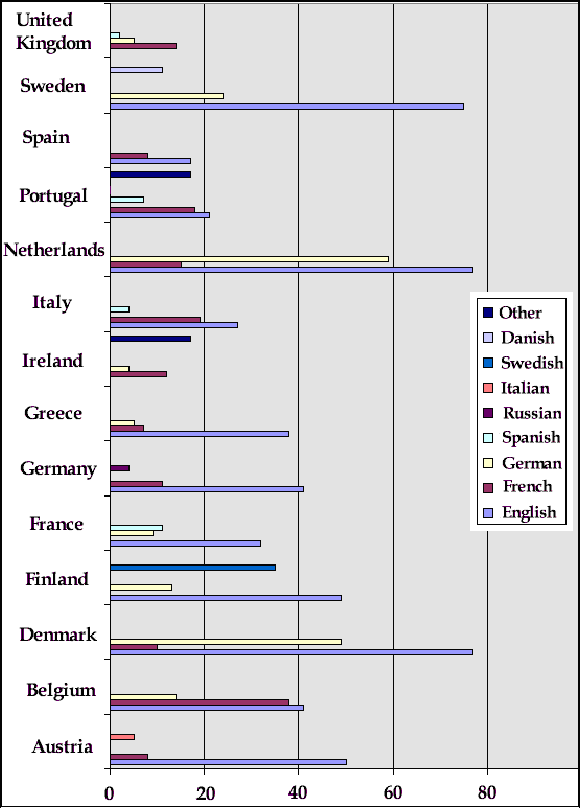
Table 1 (Europa: Gateway to the European Union) shows that German is most widely spoken as a mother tongue, and that English is spoken by almost half of the population of the European Union, a strikingly large number. Table 2 (Europa: Gateway to the European Union) shows the three most widely spoken languages apart from the mother tongue for each Member State, and the percentage of people speaking them, which also illustrates the great influence of English in the EU.
Table 2 : The languages spoken in each Member State of EU 15[17] 1998
Apart from their mother tongue, approximately three in four people in the Netherlands (77%), Denmark (77%) and Sweden (75%) can speak English well enough to take part in a conversation.[18]
|
Knowledge of English, French and German as a ‘second’ language (in % by Member State)
|
||
|
Country |
Language |
1990 1998 Difference |
|
EU 12/15[19] |
English French German |
23 31 + 8 11 12 + 1 7 8 + 1 |
|
Belgium |
English French German |
32 41 + 9 32 38 + 6 18 14 - 4[20] |
|
Denmark |
English French German |
68 77 + 9 7 10 + 3 45 49 + 4 |
|
Germany |
English French |
34 41 + 7 8 11 + 3 |
|
Greece |
English French German |
25 38 + 13 6 7 + 1 4 5 + 1 |
|
Spain |
English French German |
10 17 + 7 9 8 - 1 1 1 0 |
|
France |
English German |
26 32 + 6 9 9 0 |
|
Ireland |
French German |
14 12 - 2 3 4 + 1[21] |
|
Italy |
English French German |
18 27 + 9 16 19 + 3 3 3 0 |
|
Luxembourg |
English French German |
37 45 + 8 86 86 0 88 77 - 11 |
|
The Netherlands |
English French German |
62 77 + 15 14 15 + 1 55 59 + 4 |
|
Austria |
English French |
NA 50 - NA 8 - |
|
Portugal |
English French German |
23 21 - 2[22] 23 18 - 5 2 2 0 |
|
Finland |
English French German |
NA 49 - NA 3 - NA 13 - |
|
Sweden |
English French German |
NA 75 - NA 5 - NA 24 - |
|
United Kingdom |
French German |
16 14 - 2 6 5 - 1[23] |
Table 3: Knowledge of English, French and German as a ‘second’ language
According to table 3, taken from the European Commission Eurobarometer, a report on the public opinion in the European Union, (Europa: Gateway to the European Union), in 1998, the proportion of people who can speak English well enough to take part in a conversation had increased in most of the Member States in comparison with 1990 and to a much higher percentage than any of the other languages. The largest increases are noted in the Netherlands (+15%), Greece (+13%), Belgium, Denmark and Italy (+9%), which could be related to their compulsory foreign language education.
Furthermore, when asked what the most useful language is to know apart from the mother tongue, an overwhelming 69% of the EU population thought it to be English (release: March 1999).
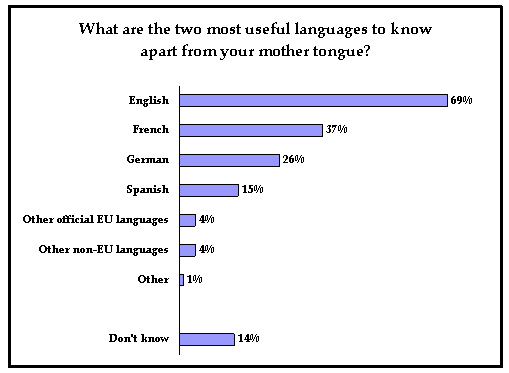
Table 4 : The two most useful languages to know apart from the mother tongue
These figures unmistakably indicate that English is already accepted as
the international language par excellence by the
majority of the EU population, which could suggest that the introduction of the
English language as the only working language of the European Union would be
relatively uncomplicated. Nevertheless,
quite some Member State citizens do not actually look forward to such an
important change as English becoming de jure the only working language of the
EU. At the beginning of 2004, the Dutch association ‘Onze Taal’ conducted an
inquiry among 315 visitors of their website. Having read all the reactions, I
could conclude that of these visitors, approximately 33.3%
were in favour of this change and the other 66.7%
voted against it. However, such a reaction could be expected at the
implementation of any major change in the language structure of the European
Union, irrespective of the language involved.
Following the purpose of this thesis, it is worth mentioning that the EU portal
site does not provide any information on the exact degree of language skill as
discussed from table 1 onwards. Of course the level of communication within the
European Union is such that it requires a high level of proficiency from both
citizens, EU politicians, officials, translators and interpreters.
In the case of English, a basic learning – which, in many EU countries, is already obtained in secondary school due to compulsory foreign language education - covers a major part of the English idiom and grammar, which entails that, besides the investment in the increase of language proficiency and an elaboration of professional jargon of the European Union, there is relatively less need for investments in the expansion of the language itself or education of the language basics.
However, one of the possible disadvantages of a possible introduction of English as a working language of the European Union is that it could increase the political advantage of native English speakers, which creates inequality among EU Member States on the basis of language. It is understandable that, at least in the first phase of the introduction of English as the official language, native English speakers are able to express themselves more subtly than non-native speakers. Also, the political weight of originally English-speaking countries might be considered as unequal when compared to the influence of the other, non-native, Member States. Many Member State citizens and even authorities are extremely nettled over a possibility of a euro-critical country as Great Britain benefiting from such a dominance.
Another disadvantage that might be incorporated into this action, is the loss of
domain of national languages,
causing less emphasis on other foreign languages and cultures. This possibility
could even emphasise the increase of political weight of originally
English-speaking countries, which might lead to fervent objections against the
option that has hereby been put forward.
When European Union officials are made aware of these disadvantages, however,
they can surely be avoided by taking active preventive actions[24]
and by informing both the authorities and the citizens of all EU Member States
of these actions and its consequences. As long as there are certain rules in
connection to a potential political advantage of native English countries or a
latent loss of domain of national languages, the introduction of English as the
official language of the European Union is undoubtedly a possibility worth
consideration.
3.2 Artificial language: Esperanto
In 1887 the Russian Dr. L.L. Zamenhof (1859-1917) published a so-called Lingvo Internacia (International Language) under the alias “Dr. Esperanto”, meaning ‘one who hopes’. This Lingvo Internacia was later to be called Esperanto.
This language was introduced as a second language that would enable international communication, without the interference of a language of another culture. Needing to converse a language that is not the mother tongue restricts speakers in their language use and causes a situation in which they cannot express themselves as well as native speakers. Esperanto was developed in order to overcome this language predominance. It is claimed to have a very simple and logical grammar and idiom, which enables learners of Esperanto to master the language more quickly than learners of many other languages.
When it comes to actual figures on the number of speakers of Esperanto, it is extremely difficult to come to an exact number. There are several national and international organisations of Esperanto active to promote and invest in the language as a means of international communication. The number of members of these organisations may, however, be only the tip of the iceberg of the total amount of speakers. Apart from these “registered speakers”, many individuals are speaking and learning to speak the language through unofficial meetings and online courses.
In The World Almanac and Book of Facts (Culbert 1998) , for instance, Dr. Sidney
Culbert indicates that approximately two million people throughout the world
speak the language, whereas Roland Breton writes, in his Atlas des Langues du
Monde (Breton 2004), that there are approximately 500,000 active speakers of
Esperanto. In an attempt to explain this wide spread, Dr. Culbert writes:
“[...] I have personally
conducted an on-the-spot stratified sampling of populations in dozens of
countries during a period of over twenty years, using hundreds of hours in
attempting to trace down every person within the selected areas of the selected
countries who meet my criteria of "speaker of Esperanto." [...] It is, however,
annoying to go to elaborate, carefully-planned, and time-consuming efforts to
obtain data nowhere else available, and then to have the results incompetently
criticized by someone who bothers neither to read the material carefully nor
check on the "facts" which he offers in criticism.”
When asked what his definition of "to speak Esperanto" is, he uses the
definitions:
Pronunciation: Sometimes foreign but always intelligible
Grammar: Good control of most basic syntactic patterns; always conveys meaning accurately in reasonable complex sentences
Vocabulary: Adequate for participation in all general conversation and for professional discussions in a special field
Fluency: Rarely hesitant; always able to sustain conversation through circumlocution
Comprehension: Understands most of what is said; can follow speeches, clear radio broadcasts, and most conversations between native speakers, but not in great detail.
The explanation for the data spread between Culbert and Breton can be found in
the criteria used for ‘speaker of Esperanto’. Culbert claims that a speaker of
Esperanto is one who “understands most of what is said” and can speak the
language in such a manner that is “adequate” and “rarely hesitant”. It is safe
to suggest that Breton would find these criteria too superficial and that he
maintains relatively strict criteria in comparison to Culbert.
Teachers of Esperanto have also been asked to give an estimation of the number of Esperantists, the result of which are the following statistics (geocities.com/ Paris/867/nombronl.htm) :
500 - 1,500 speak Esperanto daily (at home or at work)
5,000 – 15,000 speak the language as well as those who speak it daily
50,000 – 150,000 speak Esperanto very well
500,000 – 1,500,000 speak Esperanto to a reasonable degree
5,000,000 – 15,000,000 have once learnt to speak it, but can hardly speak it anymore
These figures also contain the number of participants in online courses of Esperanto. The international organisation of Lernu!, for example, has now over 10,000 students, but there are many more international and several national Esperanto organisations, listed and unlisted, offering online courses (lernu.net).
It is clear that these estimates are only just that and that it is exceptionally
difficult, if not impossible, to state a near to exact number of Esperantists.
The only number that we can be clear about, is the amount of members of official
Esperanto organisations. The UEA (Universala Esperanto-Asocio
or Universal Esperanto Association) is the largest neutral association of
organised Esperantists worldwide. With respect to the European Union Member
States, the following number of UEA members were listed in 2003 (“Revuo
Esperanto: Annual Board Report 2003”):
|
|
Associated Members[25] |
Individual Members |
Total |
|
The Netherlands |
277 |
259 |
536 |
|
Belgium |
641 |
148 |
789 |
|
Luxembourg |
97 |
13 |
110 |
|
France |
564 |
601 |
1165 |
|
Spain |
325 |
142 |
467 |
|
Portugal |
77 |
12 |
89 |
|
Great-Britain |
403 |
166 |
569 |
|
Ireland |
50 |
16 |
66 |
|
Germany |
682 |
549 |
1231 |
|
Austria |
50 |
50 |
100 |
|
Italy |
821 |
204 |
1025 |
|
Greece |
93 |
16 |
109 |
|
Denmark |
133 |
90 |
223 |
|
Sweden |
400 |
215 |
615 |
|
Finland |
210 |
200 |
410 |
|
Estonia |
25 |
27 |
52 |
|
Latvia |
62 |
15 |
77 |
|
Lithuania |
83 |
44 |
127 |
|
Poland |
100 |
81 |
181 |
|
Czech Republic |
152 |
77 |
229 |
|
Slovakia |
78 |
32 |
110 |
|
Hungary |
137 |
85 |
222 |
|
Slovenia |
100 |
20 |
120 |
|
Malta |
35 |
2 |
37 |
|
Cyprus |
0 |
1 |
1 |
|
Total |
5,595 |
3,065 |
8,660 |
Table 5 : Members of the UEA in 2003
These numbers do not reveal much about the actual total of Esperantists in the European Union, however, since there are still many other official and unofficial organisations, such as local and categorial clubs[26], and speakers of Esperanto who are not listed anywhere. Nevertheless, we can safely say that the number of Esperanto speakers is relatively small. One of the reasons may be connected to the lack of serious financial strength.
When focusing on the finances of the UEA, the following statistics apply to the
organisation’s financial situation at the end of 2003: an annual turnover of
€ 494,730,- and a balance sheet adding up to €
4,183,454,-. Comparing these figures to the financial status of the British
Council, for instance, we note that the British Council’s annual turnover will
very likely come to a total of € 728,250,000,-[27]
in 2004. Unlike the UEA, the British Council can depend on a core grant-in-aid
from the Foreign and Commonwealth Office and other UK government grants, which
clearly explains why the UEA turnover is merely 0.07% of the British Council’s.
As long as nothing is done about it, the future of the UEA, and with that an
important pillar of the Esperanto movement, will become particularly insecure.
The introduction of Esperanto as the working language of the European Union
would involve several advantages, stated below.
In spite of the unfavourable financial situation and relatively small number of speakers of Esperanto, the UEA and other Esperanto organisations continue to labour in the cause of the development and promotion of the language. In a July 2004 contribution to their website, TEJO, the World Esperanto Youth Organisation, claims that Esperanto “is most useful for neutral communication. This means that Esperanto does not favour a certain people […] and promotes an atmosphere of equal rights, tolerance and true internationalism. This can be seen in Esperanto conferences, books, magazines, music, the Internet, and even in private and family life”. The UEA adds (on Esperanto.Net): ”Esperanto's purpose is not to replace any other language, but to supplement them: Esperanto would be used as a neutral language when speaking with someone who doesn't know one's own language. The use of Esperanto would also protect minority languages, which would have a better chance of survival than in a world dominated by a few powerful languages”.
These advantages would ensure lingual and political equality among all Member
States, which means that, among other things, there can be room for more
emphasis on foreign language education and all Member States can participate in
a political debate on the same footing, a situation that can not be reached if a
natural language such as English would be used as a working language. These and
other advantages, but also some disadvantages, should not be overlooked. We will
analyse the most prominent below.
If European Union officials would take the effort of investing in the future of
Esperanto, it would become clear that introducing Esperanto as a working
language of the European Union could solve the problem of a possible political
advantage of countries over other Member States, as might be the case with
native speakers, who can express themselves more subtly in their mother tongue
than non-native speakers. In the case of Esperanto, all speakers have to go
through the same learning process in acquiring the language, which creates an
equal situation for all; there is no distinction between natives and
non-natives, since virtually all speakers start out as novices.
Another advantage is the fact that Esperanto is not connected to a specific country, a given that rules out even more the possibility of one Member State gaining a political advantage over another. Next to that, the chance of national languages losing domain is not as high as in the potential situation of introducing English as the official language of the European Union because of the lack of an Esperanto country or power. This allows more than enough room to focus on the country and culture of the Member State itself, on foreign languages in general (including English), involving a broader orientation on Europe in general. Furthermore, Esperanto has not penetrated or influenced the national languages as English has; many national languages make use of English loan words, which influence its vocabulary and even its culture, which in its turn entails more difficulty in maintaining the emphasis on the education of national languages and cultures.
If Esperanto would be introduced as the working language of the European Union,
several disadvantages would be involved as well, which are connected to the
facts that there is yet but a small number of Esperanto speakers and that
communication in the public domain requires a high degree of language
proficiency.
One result of the introduction of Esperanto would be the sudden rise in the
number of Esperanto learners and thus the need for an increase in new study
materials, tuition and the financial means to invest in the language of
Esperanto, an unfamiliar language to many, the acquisition of which takes time,
money and effort.
A more cogent disadvantage is the fact that, even though it is possible to learn
Esperanto easily and quickly, there is still a period of time in which the
language needs to be acquired or is not yet fully mastered. This applies to both
citizens and translators and interpreters (from whom a much higher level of
speech and comprehension is expected), entailing that the introduction of this
language as the only working language of the European Union
does not immediately solve the current translational problem. The fact
is, however, that as soon as the language is mastered, the communication
problems of the European Union can be solved on both practical and economical
level.
3.3 Final recommendations
Adding up, we find three possible solutions to the lingual and translational
problem in the European Union:
1) A reduction of the number of working languages in the EU to the three
most widely spoken languages in the EU, namely
English, German and French.
2) A reduction of the number of working languages in the EU to one: English.
3) A reduction of the number of working languages in the EU to one: Esperanto.
The first option would drastically reduce translation
costs and prevent the accumulation of backlogs, but the implementation of these
languages as working languages involves an increase in political power of its
countries and cultures over other Member States. Such a political triangle might
even benefit from more influence and control than a single State, which
might give raise to many objections, as we can deduce from the political
triangle of Blair, Schröder and Chirac.
The second and third option would definitely present us with a more advantageous financial situation, though a thorough assessment needs to be made on the choice of language. The two languages under discussion are English and Esperanto, both bringing along their own advantages and disadvantages.
The benefits of introducing the English language as a working language of the
European Union are that:
- English is already spoken as a second language accepted as an international language by the majority of the EU population, which could make the introduction of English as the single EU language relatively uncomplicated.
- Besides the investment in the increase of language skills and an elaboration
of professional jargon of the European Union, there is relatively little need
for additional investments in the expansion or education of the language basics
due to compulsory English language education in many Member States.
Possible disadvantages are:
It could increase the political advantage of native English speakers, which creates inequality among European Union Member States on the basis of language.
There could be an ongoing loss of domain of national languages and less emphasis on the education of other foreign languages and cultures; an excessively one-sided focus on the English-speaking world.
When focusing on Esperanto, the following advantages can be noted:
There could be no political advantage of one country over another, because Esperanto is not connected to a specific country and all speakers have to go through the same learning process in acquiring the language, which creates an equal situation for all.
The chance of national languages losing domain is not as high as in the potential situation of introducing English as a working language of the European Union because of the lack of a country and economical and politico-military force of Esperanto that might benefit from such supremacy over EU Member States.
Possible disadvantages are connected to the facts that there is yet but a small number of Esperanto speakers and that communication in the public domain requires a high degree of language proficiency:
The sudden rise in the number of Esperanto learners causes a need for an increase in new study materials, tuition and the financial means to invest in the language of Esperanto.
There is a terminology gap in the vocabulary of Esperanto, which therefore needs to be updated.
There is still a period of time in which both citizens and translators and interpreters (from whom a much higher level of speech and comprehension is expected) need to acquire and master the language, entailing that the introduction of this language as the only working language of the European Union does not immediately solve the current translational problem.
Furthermore, we have seen that the disadvantage of the introduction of either language is the fact that a high level of proficiency is needed for communication in the public domain, which requires thorough language training. Besides this fact, we can conclude from the above list of pros and cons that the disadvantages of English are situated mainly on political level, whereas the introduction of Esperanto would take up much more time than the introduction of a natural language such as English. It is clear, however, that the European Union’s main concerns should be not to let any Member State profit from a political advantage over another and that the national languages and cultures of EU Member States should not be disregarded.
In meeting these concerns, we would rather incline towards the option of introducing Esperanto as one or even the only working language of the European Union. However, since this would involve such a major change in language structure in the Union that is likely to give rise to many objections within the EU institutions and possibly even beyond, we should at least plead for Esperanto to be financially supported by the European Union in order for it to develop as a strong language. In due time, the EU may choose for the implementation of Esperanto as one of the working languages of the EU, which might eventually lead to a situation in which the majority of Member State citizens and authorities speak the language to a high degree, after which Esperanto may even become the only working language of the Union. Until then, however, we should at least not exclude this language from EU subsidies, preventing it to develop and expand. Without the financial support and attention from the European Union, Esperanto will not live to see another century, and, for all we know, we might just need it.
"Acquis
Communautaire."
BBC News
30 April 2001
<
http://news.bbc.co.uk/1/hi/in_depth/europe/euro-glossary/1216329.stm>
Beunderman, Mark. “EU Translation Problems Cost Lives, Says UK.” EU Observer 28 July 2004 <http://www.euobserver.com>
Breton, Roland. Atlas des Langues du Monde: une Pluralité Fragile. Autrement, 2004 <http://www.geocities.com/Paris/867/nombronl.htm>
British
Council.
2 December 2004
<http://www.britishcouncil.org>
Collins Cobuild: English Dictionary. London: HarperCollins Publishers. 1998
Culbert, Sidney. The World Almanac and Book of Facts. New York: World Almanac. 1998 <http://www.geocities.com/Paris/867/nombronl.htm>
Esperanto.Net: Multilingual Information Centre for Esperanto. 1 March 2000
<http://www.esperanto.net>
“EU Millions to go on Translation.” BBC News 18 February 2004 <http://news.bbc.co.uk/1/hi/world/europe/3499393.stm>
Europa: Gateway to the European Union. 2004. European Union. 8 July 2004 <http://europa.eu.int>.
“European Commission Tries to Tackle Translation Nightmare.” MaltaMedia News 30 May 2004 <http://www.maltamedia.com/news/2004/eu/printer_2007.shtml>.
”Governance and Funding.” British Council 1 November 2004 <http://www.britishcouncil.org/home-about-us-governance-funding.htm>
Leitner, Gerhard. “English-only Europe? Challenging Language Policy.” Linguist List 14.2624 29 September 2003 <http://linguistlist.org/issues/14/14-2624.html>.
Lernu! 2001. Esperanto@Interreto. 1 November 2004 <http://www.lernu.net>
Longman, Chris. “The Convention as Communicative Environment: The challenge of multilingual deliberation.” Workshop Stirling December 2004
<http://www. arena.uio.no/cidel/WorkshopStirling/PaperLongman.pdf>
Mahony, Honor. “New Member States face Urgent Translation Deadline.” EU Observer 8 March 2004 <http://euobserver.com>.
McCrum,
Robert, William Cran, and Robert MacNeil. The Story of English. London:
BBC Publications, 1987.
“New
Tower of Babel? Can the EU work with 21 languages?” Tiscali.Europe.
London 22 October 2002
<http://europe.tiscali.co.uk>
Ogden’s BASIC English. Marshalltown: Basic English Institute 28 January 2004
<http:// www.basic-english.org/>
“One EU
currency, one EU language.”
(Translation from: “Na één Euromunt, één
Eurotaal.”) De Standaard: Belgium 31 July 1997
Onze Taal. “Hom of Kuit: it is desirable for English to become the working language of the European Union.” March 2004
Phillipson, Robert. English-Only Europe? Challenging Language Policy. London and New York: Routledge, January 2003.
QCA. “Key statistics about modern foreign language teaching in England.” The National Literacy Trust: 2004-12-20
<http://www.literacytrust.org.uk>
Strickland, Agnes. LoveToKnow 1911 Online Encyclopedia. 2003. LoveToKnow 2004
<http://58.1911encyclopedia.org/s/st/strickland_agnes.htm>
Swaan, Abram de. Conference: European Language Constellation. Oegstgeest 11 October 1999
TEJO, the World Esperanto Youth Organisation. “What is Esperanto?” 28 July 2004
< http://www.tejo.org>
“The British need to be multilingual, say envoys.” Daily Telegraph: London 16 February 2001
<
http://www.telegraph.co.uk>
The
Oxford English
Dictionary.
Oxford: Oxford University Press 1989
<http://dictionary.oed.com/>
“Three leaders deny bid to dominate EU” International Herald Tribune. Berlin 19 February 2004
<http://www.iht.com>
Universala Esperanto-Asocio. “Revuo Esperanto: Annual Board Report 2003.” Report, Rotterdam, 2003.
| home | list theses | contence | previous | next |
[1] “The entire body of European laws is known as the acquis communautaire. This includes all the treaties, regulations and directives passed by the European institutions as well as judgements laid down by the Court of Justice. The term is most often used in connection with preparations by the candidate countries to join the union. They must adopt, implement and enforce all the acquis to be allowed to join the EU. As well as changing national laws, this often means they must set up or change the necessary administrative or judicial bodies which oversee the legislation. For enlargement negotiations, the acquis have been divided into 31 chapters, each of which must be 'closed' by the candidates.” ("Acquis Communautaire", BBC News).
[2] The European Commission is a body with powers of initiative, implementation, management and control. It is the guardian of the Treaties and the embodiment of the interests of the Community (Europa: Gateway to the European Union).
[3] Although the EU language regime as outlined in Article 1 of Regulation No. 1, 1958 (as amended following subsequent enlargements: “The official languages and the working languages of the institutions of the Community shall be Danish, Dutch, English, Finnish, French, German, Greek, Italian, Portuguese, Spanish and Swedish”) defines all official languages as being equivalent to working languages, in practice there is a difference between ‘working languages’ at the political level and ‘working languages’ at the official level. In general, within the EU institutions, the secretariats use only English and French as working languages (Longman, 2004).
[4] Publicist and teacher of Literature at the University of Antwerp.
[5] “The European Commission's Directorate-General for Translation is the largest translation service in the world. Located in Brussels and Luxembourg, it has a permanent staff of some 1300 linguists and 500 support staff, and also uses freelance translators all over the world. Known as the DGT after its English initials, the service translates written text into and out of all the EU's official languages, exclusively for the European Commission. Interpretation of the spoken word is the responsibility of the Directorate-General for Interpretation” (Europa: Gateway to the European Union).
[6] “Agnes Strickland (1806-1874), English historical writer, was born in 1806, the third daughter of Thomas Strickland, of Reydon Hall, Suffolk. Her first literary efforts were historical romances in verse. From this she passed to prose histories, written in a simple style for the young” (Strickland, 2003).
[7] The European Parliament is the assembly of the representatives of the Union citizens. Its main functions are to consider the Commission's proposals and be associated with the Council in the legislative process, in some cases as co-legislator, by means of various procedures; also, it has the power of control over the Union's activities through its confirmation of the appointment of the Commission (and the right to censure it) and through the written and oral questions it can put to the Commission and the Council; furthermore, it shares budgetary powers with the Council in voting on the annual budget, rendering it enforceable through the President of Parliament's signature, and overseeing its implementation (Europa: Gateway to the European Union).
[8] The European Council is the term used to describe the regular meetings of the Heads of State or Government of the European Union Member States (Europa: Gateway to the European Union).
[9] The Court of Justice of the European Union is composed of as many judges as there are Member States. Its two principal functions are to check whether instruments of the European institutions and of governments are compatible with the Treaties and to pronounce, at the request of a national court, on the interpretation or the validity of provisions contained in Community law (Europa: Gateway to the European Union).
[10] “The Joint Interpreting and Conference Service, the SCIC (from the French acronym), provides […] interpretation in meetings arranged by the Commission and the other Institutions it serves, and provides a conference organising capacity to Commission services. The SCIC makes possible multi-lingual communication when people speak, which is at the core of Community decision-making. Written texts are translated by the European Commission's Translation Service.” (Europa: Gateway to the European Union).
[11] “The overheads of a business are its regular and essential expenses, such as salaries, rent, electricity, and telephone bills.” (Collins Cobuild)
[12] The total cost divided through 383,333,333 (as the number of EU citizens in 2003).
[13] Compare to 615,100 word forms defined and/or illustrated in the second edition of The Oxford English Dictionary of 1989 (OED), although the vocabulary of an average speaker of English is in all probability far more limited.
[14] Note that these official languages do not contain any regional, but only national languages.
[15] Excluding Ireland, Luxembourg, Belgium and Austria because of the use of unofficial or other national languages.
[16] The figures for German, French and English in this column can also be found in table 3.
[17] Luxembourg, also part of the EU 15 (the 15-country EU prior to the 2004 expansion), is not included in this table. However, the website does mention the following: “People in Luxembourg (86%) are most likely to speak French well enough to take part in a conversation.” and “In Luxembourg, 77% of people who do not consider German as their mother tongue can speak it well enough to take part in a conversation” (Europa: Gateway to the European Union).
[18] According to the website, “[r]espondents were asked: ‘Which languages can you speak well enough to take part in a conversation, apart from your mother tongue?’ The percentage in each country that speaks another language is calculated by subtracting the percentage of "don't know" responses from the total” (Europa: Gateway to the European Union).
[19] Excluding the native countries the United Kingdom, France and Germany, in order to obtain a clearer view of the actual knowledge of the three languages as a ‘second’ language.
[20] The website does not provide any information on the reasons for the deterioration of the official schoolroom language German in Belgium. It is likely that this is due to the increasing emphasis on French (because of the Francophone regions in this country) and English (as the main language in new media) and therefore a slight decrease in emphasis on German.
[21] see footnote 20
[22] The decrease in foreign language skills in Portugal may be connected to the high drop-out rate between school and work in the 1990’s. Furthermore, the ending age of compulsory schooling in Portugal is 14, which is relatively low compared to other countries.
[23] Possible reasons for the poor foreign language skills in the UK and Ireland are: “only about 21% of primary schools offer some form of language teaching; the most frequently cited reason schools stop teaching modern languages is that fulfilling the statutory requirements of the national curriculum is a higher priority; the time allocated to language teaching increases through the primary years, reaching an average peak of one hour a week in independent schools and 45 minutes in state schools; most of those teaching languages in primary schools do not have languages as their main responsibility; many primaries have no link with their local secondaries for language teaching” (QCA) (also read: “The British need to be multilingual, say envoys”).
[24] Such as compulsory foreign language education next to English and information on the importance of such a drastic change in the language structure of the European Union.
[25] Associated members are members of a national Esperanto-organisation that is affiliated with the UEA; these members are therefore considered ‘indirect’ members of the UEA. Individual members are directly registered as members of the UEA.
[26] Examples of categories that involve an Esperantist background are religion, vacation, hobbies, Scout Associations and so on.
[27] 1 GBP = 1,45 EUR