| The Function of Food and Dinner in Sir Gawain and the Green Knight. (Marije Pots) |
| home | list theses | contence |
It would almost seem like a therapy session: to ask someone to close his or her eyes, and imagine the Middle Ages. Just visualising it would not be enough, however. You should be able to feel it, smell it, as if you are part of a painting which suddenly comes alive. What would you dream of? Would you work the fields with the peasants, or visit a nobleman’s house? Not a very difficult question, you would say. But then this one: Would you want to be in Robin Hood’s band, or be one of King Arthur’s knights? There the choice would be harder to make. Let’s pick the last one, since the courtly luxury of the otherwise so dark and gloomy Middle Ages would almost certainly appeal to many. You would probably picture Camelot, the large and beautiful castle of King Arthur and Queen Guinevere. You would walk through the long and narrow passageways, illuminated by torches, which all come out onto a huge hall, with the highest ceiling, like a church. There would be very magnificently decorated tapestries hanging from the walls, and long tables standing in the middle of the chamber. Many people, barons, dukes, knights and ladies, wearing the most beautiful clothes, would occupy the tables, which are filled with so many different kinds of food, that one could hardly see the plates anymore. It would closely resemble a dining scene from one of the Harry Potter books by J.K. Rowling, where everyone is seated in a large hall, treated to the dishes they love most, and where the persons of highest importance are seated upon some kind of platform. In this medieval dream, one of the persons on the dais is dressed most superbly, and has a distinguished air around him. You will know in an instant, as if you have already seen him before, that this is King Arthur. Although everything seems perfect, and the food looks so delicious you could almost taste it yourself, the king is not eating, nor are most of the people in the hall. Everybody knows that there will not be any filling of their empty stomachs, until King Arthur, and with him all of them, has been entertained.
This daydream is not just an anecdote that has blindly been picked out of a huge pile of Arthurian stories. The whole picture which has just been drawn here recurs in one Arthurian romance after another. The poem Sir Gawain and the Green Knight is a very splendid example of this[1]. In this work, King Arthur’s reluctance to start eating without having been entertained is described very elaborately. The author makes known to us that the legendary king:
[…] wolde neuer ete
Vpon such a dere day er hym deuised were
Of sum aventurus þyng an vncouþe tale,
Of sum mayn meruayle, þat he my3t trawe,
Of alderes, of armes, of oþer auenturus,
Oþer sum segg hym biso3t of sum siker kny3t
To joyne with hym in iustyng […] (l. 91-97) [2].
[[…] would never eat
upon such a festive day before he had been told
a novel tale of some perilous incident,
of some great wonder, which he could believe true,
of princes of old, of feats of arms, or other adventurous deeds,
or until someone had begged him for some trusty knight
to join with him in jousting […].]
This interesting fact, together with the explicit dinners and dining customs which surround it, has been allotted quite a large number of lines in this work. In fact, the Gawain-poet has dedicated a considerably large part of the poem to food, dinner and dining customs. To find out the exact function and significance of these meals in relation to the narrative of SGGK, I will give a detailed analysis of all the passages in this poem in which food plays a part. Eventually, I hope to show that all the meals and dinners described in this Arthurian romance have been assigned a specific role by its author. The analysis of this work, written by a very talented but unknown medieval author, will show that if “literary motifs and devices should be as rich and varied as courses of a banquet, then” this romancer gave “us no less of a treat than the one [his] fictional hosts provide for their guests” (Putter 1995, 54-55).
There are several things which I wish to discuss in order to draw a clearer picture of food and dinner in SGGK. In order to keep a clear view of everything that is going on in the poem, I will discuss the food scenes and everything which has something to do with them in textual order. The Gawain-poet has divided the poem into four sections, or fitts, and I will follow this example in my paper. In the first chapter I will examine the first fitt. Here, the story takes place at King Arthur’s court, and I will discuss the Christmas dinner scene, the king’s peculiar habit, the arrival of the Green Knight and the decapitation of this apparition.
In the second chapter, the focus will move away from the New Year’s Day dinner at Camelot in fitt I, to Sir Gawain’s farewell party in fitt II. The knight’s quest for the Green Chapel, his arrival at castle Hautdesert and his stay there during the Christmas festivities fill the remainder of the section and as such also of this chapter. Practically each event during the first half of the story involves a scene in which food plays a role. Most of the dinner scenes in this fitt take place at the castle of Sir Bertilak, but there are also interesting scenes which take place outside the safety of the castle. I will examine the way the feasts are portrayed by the Gawain-poet, and the action which takes place during these dinner scenes.
In the third chapter of this paper, I will discuss the third section of the poem, which describes the exchange of winnings, in which both Sir Bertilak’s hunting and Sir Gawain’s adventures at the castle include some interesting scenes in which food plays a role. In the fourth chapter, I will discuss the final section of SGGK, in which the number of references to food and dinner diminishes drastically. The fourth fitt opens with the morning on which Sir Gawain has to meet the Green Knight. His journey to the Green Chapel, the fulfilment of the exchange of blows game and his return to Camelot hardly contain any references to food. As this stands in contrast to the abundance of food in the remainder of the poem, it is all the more interesting to find out the meaning of this reduction. In the final chapter of this paper I will therefore present my conclusions.
Now the time has come to go back to the dream about knights, castles and wonderful feasts. Try to go back in time and imagine everything so vividly that you can almost smell the various dishes on the tables. The dining table filled with the loveliest dishes which even the king would only have been able to taste during such a special day as Christmas, would surely have made everyone’s mouth water. In the poem this dinner is described in considerable detail:
Dayntés driven þerwyth of ful dere metes,
Foysoun of þe fresche, and on so fele disches
Þat pine to fynde þe place þe peple biforne
For to sette þe sylueren þat sere sewes halden
On clothe.
[…]
Ay two had disches twelue,
Good ber and bry3t wyn boþe (l. 121-29).
[With that there came in rare dishes of the richest foods,
fresh meat in plenty, and on so many plates
that it was difficult to find room before the diners
to set upon the cloth the silverware which held
the various stews.
[…]
Each couple had twelve dishes,
good beer and bright wine as well.]
Imagine having all of this lovely food in front of you, all the meat, fish, poultry, fruits, drinks and desserts, and add a huge rumbling in your stomach to it. If you follow the king’s example, however, you will not even be allowed to take a sip of wine, let alone eat a crumb of bread. So, please, let the entertainment begin before we all starve!
Beer, Wine and Blood: A Typical Arthurian Christmas
SGGK opens with a description of Britain’s foundation by Felix Brutus, the isle’s first king. Many kings have followed in his footsteps, none of whom have been as honourable as King Arthur: “Bot of alle þat here bult, of Bretaygne kynges / Ay wat3 Arthur þe hendest, as I haf herde telle” (“But of all who lived here, of the kings of Britain, Arthur, as I’ve heard tell, was the noblest ever”, l. 25-26). Therefore, it is this leader and his knights of whom the Gawain-poet has chosen to relate. Presumably as a means to explain King Arthur’s claim to the title “þe hendest”, the author has chosen to depict the king and his men during a season filled with joviality and mirth: the first fitt takes place at Camelot during the Christmas festivities. Although the first fitt is the shortest in the poem, it includes more lines on food, dining and dinner customs than any of the other three fitts. Almost twenty percent of the section is concerned with this topic (see Figure 1). This shows that dining plays a major role in this part of the poem, and therefore I will use this first chapter to take a better look at each line in the first fitt which is concerned with dinner traditions. On the whole, the first fitt can be divided into three topics which are in harmony with the food and dining, namely the dinner traditions at Camelot, King Arthur’s “no adventure – no dinner” custom, in which he “wolde not ete til al were serued”, and the reception of the Green Knight, or rather the hospitality shown towards him.
Figure 1:
|
|
Total of Lines |
Stanzas |
Lines Concerning Dinner |
Percentage |
|
Fitt I |
490 |
21 |
90 |
18,4 % |
|
Fitt II |
635 |
24 |
57 |
9 % |
|
Fitt III |
872 |
34 |
34 |
3,9 % |
|
Fitt IV |
533 |
22 |
1 |
0,2 % |
Dinner Inventory: the percentage of lines dedicated to food, dining and dinner customs in each fitt.
1.1 Camelot’s Splendid Christmas Festivities
The first fitt takes place at a hibernal Camelot during Christmas time, but there is much more to the story than that. The length of the Christmas festivities for King Arthur and his entourage, for example, differs considerably from what we are used to nowadays, with Christmas Eve, Christmas Day, and Boxing Day. Medieval Camelot overflows with celebrating knights and ladies expecting the most exquisite food and the best behaviour from the host from Christmas Eve until the beginning of January: “Þe fest wat3 ilyche ful fiften dayes, / With alle þe mete and þe mirþe þat men couþe avyse” (“The celebrations went on continuously for fully fifteen days, with all the feasting and merry-making which could be devised”, l. 44-45). The Gawain-poet rushes through these two weeks, and only slows down to describe the celebrations on New Year’s Day, but these two lines alone are enough to imagine all the joy the occupants and visitors of Camelot have during the remainder of the holiday. Derek Brewer thinks that the number of days has not been picked randomly: “The fifteen days of Arthur’s feast is the traditional Arthurian and romance period. ‘Fifteen’ is a ‘magic’ number from long back, found in Middle English religious formulas as well as in the period of feasts” (Brewer 1997, 137). The narrator of SGGK, however, limits himself to describing the proceedings during New Year’s Day.
At the beginning of the poem the reader is promised a wonder: “Forþi an aunter in erde I attle to schawe, / Þat a selly in si3t summe men hit holden, / And an outrage awenture of Arthure3 wondere3” (“And so I mean to unfold an actual adventure, such that some men consider it a veritable marvel, and an extraordinary episode from the strange tales of Arthur”, l. 27-29). This marvel is provided on New Year’s Day, which, however, commences without a foreboding of the adventures that will come later on. “Wyle Nw 3er wat3 so 3ep þat hit wat3 nwe cummen, / Þat day doubble on þe dece wat3 þe douth serued” (“While New Year was so young that it had just newly arrived, on the day itself the company was served with redoubled splendour at table”, l. 60-61). It begins as a day picked out of the fifteen before mentioned due to its “redoubled splendour” at the dinner table. The description of all the proceedings surrounding dinner in the great hall is splendid in itself. It seems as if nothing is forgotten.
Throughout the first fitt, the Gawain-poet mentions washing, table-seating, manner of serving, the food itself, and even the behaviour of the diners. Several of these matters are to be found in the following description:
Alle þis mirþe þay maden to þe mete tyme.
When þay had waschen worþyly, þay wenten to sete,
Þe best burne ay abof, as hit best semed (l. 71-73).
[They carried on al this merry-making until the dinner hour.
When they had duly washed, they went to table,
the noblest person always being more highly placed, as seemed most fitting.]
Although the mentioning of merry-making and the table-seating will here seem most interesting, there also is a phrase in the above quotation with a certain hygienic significance attached to it: “When þay had waschen worþyly”. Washing your hands before dinner is still a widely-spread custom, but that does not mean that one would mention it in a book. In the poem, the diners are not served individually, but have to share food with their direct neighbour, a custom to which even the king and his noble guests are used. One should note that “napkins, like forks, were not used at this time” and therefore “the cleanliness of one’s neighbour’s fingers was a matter of personal interest” (Tannahil 1973, 90 and 192). This shows that the washing of hands certainly is no luxury, and reflects the court’s status and its adherence to etiquette.
Something else which was in common use during the Middle Ages is the high table, of old a conventional table arrangement. The author’s description of Guinevere gives a further insight into this tradition:
Whene Guenore, ful gay, grayþed in þe myddes,
Dressed on þe dere des, dubbed al aboute,
Smal sendal besides (l. 74-76).
[Queen Guenevere, brilliantly dressed, was set in the midst,
placed on the dais of honour, all about her richly decorated,
fine silk around her.]
A description of the table-seating comes in conveniently for the audience, who are now enabled to picture the table seating in the Great Hall, and who are given a clear view of the main characters of the poem. The only noble person mentioned so far is Queen Guinevere and her appearance clarifies a mystery: the absence of the famous Round Table, normally a common feature of Arthurian literature. The Gawain-poet does mention the Round Table several times, but the object itself does not belong to the furniture in the Great Hall. In the poem, King Arthur is referred to as “þe ryche ryal kyng of þe Rounde Table” (“the right royal king of the Round Table”, l. 313 and 538), and the symbol in itself is twice linked with revelry and renown. Due to the mentioning of Queen Guinevere one no longer needs to ponder the omission of the visual object from the dinner scene. As Derek Brewer points out in A Companion to the Gawain-Poet, “in real life, as in medieval poems, the presence of ladies was one of the delights of the feast. Only in the original primitive twelfth-century Arthurian fantasy of the Round Table, designed to prevent quarrels over precedence, were there no seats for ladies” (1997, 142). During such a festival as Christmas, the absence of ladies would be unimaginable, which might explain the absence of the Round Table. The Gawain-poet may have chosen to mention Queen Guinevere first when referring to the noble persons placed on the dais in order to denote the attendance of ladies, and as such to increase the knights’ joy and mirth. They might have thought that a splendid meal is all the more marvellous in the presence of women.
A few stanza’s further into the poem, the poet unveils the identity of the male guests placed at the high table:
There gode Gawan wat3 grayþed Gwenore bisyde,
And Agrauayn a la dure mayn on þat oþer syde sittes,
Boþe þe kynges sistersunes and ful siker kni3tes;
Bishop Bawdewyn abof bigine3 þe table,
And Ywan, Vryn son, ette with hymseluen.
Þise were di3t on þe des and derworþly serued,
And siþen mony siker segge at þe sidborde3,
Þen þe first cors come with crakkyng of trumpes (l. 109-16).
[There the good Sir Gawain is placed beside Guenevere,
and Agravain of the Hard Hand sits on his other side,
both nephews of the king and very worthy knights;
Bishop Bawdewyn, in the seat of honour, heads the table,
and Ywain, Urien’s son, dines beside him.
They were seated on the dais and sumptuously served,
and after them many trusty knights at the side tables.
Then the first course came in with blaring of trumpets.]
The illustration of table seating is here completed. Sir Gawain, the main character throughout the following three fitts, is allotted a place on the dais as well, in fact, he is graced with a seat beside the queen. He is allotted this seat both due to his prowess as a knight and his kinship to the king. The above quotation shows that the dais serves partly as a token of reputation: “Sitting along one long side of this high table, the honored could see and be seen by all others who sat in descending order of social rank on benches or stools at long tables” (Cosman 1976, 16). Therefore, as a host it is important to pay close attention to the selection of the guests who will be allowed to sit on the dais. Especially during a festivity such as Christmas “verbinden die Mahlzeiten die Teilnehmer zu engerer Gemeinschaft” (Wiswe 1970, 85). The best agreements can be made within these joyful circumstances. Besides that, a host can assert his authority by selecting or rather by passing over certain guests when arranging table seating. This shows that dinners “served as a binding social function, and provided a site for the display and propagation of power” (Weber 1998, 151-53). They enable King Arthur to show everyone in the Great Hall which nobleman he looks upon with dignity, and which one has fallen from his grace. Bishop Bawdewyn, seated next the king, certainly belongs to the first group, because “hoe dichter bij de heer, hoe eervoller. Aan het Engelse hof heette de plaats onmiddellijk rechts van de koning de reward ” (Uytven 1998, 154).
After the Gawain-poet has made the reader acquainted with the seating arrangement, he turns to a description of the food, or rather the abundance of it:
Dayntés driven þerwyth of ful dere metes,
Foysoun of þe fresche, and on so fele disches
Þat pine to fynde þe place þe peple biforne
For to sette þe sylueren þat sere sewes halden
On clothe.
Iche lede as he loued hymselue
Þer laght withouten loþe;
Ay two had disches twelue,
Good ber and bry3t wyn boþe (l. 121-29).
[With that there came in rare dishes of the richest foods,
fresh meat in plenty, and on so many plates
that it was difficult to find room before the diners
to set upon the cloth the silverware which held the various stews.
Everyone helped himself
as he pleased, without stint;
each couple had twelve dishes,
good beer and bright wine as well.]
Even for a wealthy medieval person, there is not always much food to obtain, and “dergelijke rituele schranspartijen waren om zo te zeggen een wraakneming voor de vele dagen van kommer en kwel en van verplichte soberheid” (Uytven 1998, 154). Among the inventory of this New Year’s Day dinner, beer and wine are mentioned as well. Nowadays, these drinks would always turn an ordinary dinner into a feast, but one should note that during the Middle Ages these beverages replaced water as a necessity of life, because that liquid mostly was of poor quality or simply not on hand. Therefore, it is important to remember that “veel middeleeuwers in de eerste plaats wijn dronken om hun dorst te lessen en hun maaltijden door te spoelen en dus niet als fijnproevers” (Uytven 1998, 23). However, the fact that the author mentions “Good ber and bry3t wyn,” which King Arthur and his men only drink on special occasions, denotes that the diners surely try to escape the “verplichte soberheid.” This is illustrated by the rare dishes, the loud music and the splendid decoration of the Great Hall, as well as by the joyous atmosphere which follows from this.
In this splendid account of the dinner which King Arthur and his entourage are served, Derek Brewer is struck by the fact that the Gawain-poet has omitted “the kitchen accounts, the hundreds of animals, birds, fishes, the floods of wine and beer”, but he does add that “the visual splendour which all celebratory ceremonial aims at, is warmly conveyed” (Brewer 1991, 19-20). In fact, these kitchen accounts would not be able to compete with the effect that the dinner scene now has on both the readers and the diners. The joy and mirth which emanate from the festivities so vividly described by the Gawain-poet predominate the beginning of the first fitt. So far, everyone seems happy, and who would not be content in such an environment? The food and drink are plentiful, everybody is seated according to protocol, good manners are emphasised, the knights are accompanied by their women and the feast lasts for two weeks. The marvel which had been promised at the very beginning of the poem will, however, test the strength and duration of the joyous atmosphere during the remainder of the fitt.
1.2 King Arthur’s “No Adventure – No Dinner” Custom
Judging the dinner scene which has just been discussed, one would assume that all the diners would now set upon the food which has been set before them, were it not that there has as yet been omitted some information which will overturn this assumption. Everything and everyone seems set for an exuberant evening filled with food and drink, but it is not as it appears. King Arthur is the one who puts a spoke in the wheel of the festivities:
Bot Arthure wolde not ete til al were serued,
He wat3 so joly of his joyfnes, and sumquat childgered:
His lif liked hym ly3t, he louied þe lasse
Auþer to longe lye or to longe sitte,
So bisied him his 3onge blod and his brayn wylde.
And also an oþer maner meued him eke,
Þat he þur3 nobelay had nomen, he wolde neuer ete
Vpon such a dere day er hym deuised were
Of sum aventurus þyng an vncouþe tale,
Of sum mayn meruayle, þat he my3t trawe,
Of alderes, of armes, of oþer auenturus,
Oþer sum segg hym biso3t of sum siker kny3t
To joyne with hym in iustyng, in jopardé to lay,
Lede, lif for lyf, leue vchon oþer
As fortune wolde fulsun hom þe fayner to haue.
Þis wat3 þe kynges countenaunce where he in court were,
At vch farand fest among his fre meny in halle (l. 85-101).
[But Arthur would not eat until all had been served,
he was so youthfully light-hearted, and rather boyish;
he liked an active life, and was all the less
willing either to lie idle or to sit still for long,
his youthful blood and restless brain stirred him so.
And he was also influenced by another custom,
which he had assumed as a point of honour,
that he would never eat upon such a festive day
before he had been told a novel tale of some perilous incident,
of some great wonder, which he could believe true,
of princes of old, of feats of arms, or other adventurous deeds,
or until someone had begged him for some trusty knight
to join with him in jousting, a man ready to stake his life
against another, each allowing the other such advantage
as fortune should favour him with.
This was the king’s accustomed behaviour whenever he might be holding court,
at every splendid feast among his noble company in castle hall.]
Although this quotation is enacted in the poem before the food is served, King Arthur’s hunger for an adventure is by then still far from satisfied. The king’s unwillingness to eat at first sight seems to have its origin in a feeling of equality or hospitality towards his guests, because he does not want to indulge in his food before everyone has been served. Jonathan Nicholls comments on King Arthur’s behaviour that “a residing Lord at a banquet would normally expect to be served first; King Arthur inverts these normal rules of precedence, but does not act discourteously. Everything is still affected with the utmost attention to the requirements of good manner” (Nicholls 1985, 116-17). Further on during the description of King Arthur’s custom, however, it becomes clear that he also does not want to eat until he or one of his knights has proven himself an honourable member of the Round Table through a successfully accomplished task. It becomes clear here, that, although the Round Table is not tangibly present in this scene, its spirit does shine through.
Since King Arthur does not indulge in his New Year’s Day dinner, it would be logical to assume that his knights and all the ladies follow this example. However, this appears not to be so: as soon as everyone is served, “Iche lede as he loued hymselue / Þer laght withouten loþe” (“Everyone helped himself as he pleased, without stint”, l. 126-27), although a wonder has not yet taken place. The diners either do not doubt the brisk arrival of an adventure or they agree with the Gawain-poet, who calls King Arthur childish in the description of the king’s custom. This is probably due to the fact that the adventure or rather the “entertainment was [to the king] more important than the meal itself” (Swabey 1998, 140). The author also describes King Arthur as being very active, and says that he cannot remain seated for long. However, King Arthur’s decision to wait patiently until all are served, combined with the fact that the guests at the high table remain seated, gives rise to the assumption that the king is still seated after all. Derek Brewer tries to solve this apparent contradiction by suggesting that “Arthur stands politely chatting in front of High Table […] while all wait for something interesting to happen” (Brewer 1997, 137). This is a suitable possibility, as it enables the king to occupy himself gracefully until everybody is served, without the risk of insulting anyone. Besides that, King Arthur might be convinced that it is useless to be at the table as long as he has not seen a marvellous deed. The text itself, however, does not clearly state whether the king is sitting down or standing.
It becomes clear here that King Arthur’s “no adventure – no dinner” custom is “die Grundlage seiner Stellung als König, aber auch die Ursache seiner Ohnmacht”, because he can never be entirely sure when and even if a wonder will be presented to him (Köhler 1962, 208). Besides, no one knows when and even if the dinner party can be continued. After all, the amount of food presented in the remainder of the fitt depends on the outcome of this custom. The Celtic counterpart to the Middle English “maner”, the “geis”, would nowadays be looked upon as a taboo.[3] It has been assigned the following meaning: “any thing or act forbidden because of the ill luck that would result from its doing” (Nutt 1965, 213). King Arthur’s custom, however, does not seem to bring a chance of ill luck when it is broken, but rather when it is fulfilled. The danger lies in the fact that the realisation of the adventure which follows from the custom could have an unpleasant result, ranging from food that has gone cold to the death of a knight. That is, however, a risk which King Arthur and his knights must have been aware of when the tradition was introduced to their court. Whatever the consequences, the custom “formed a traditional code of chivalrous practice” (Reinhard 1933, 15) and the honour which could be gained from it overcame the fear of death or failure. This corresponds with the fact that King Arthur has assumed this tradition as a point of honour, as is stated in the description of the custom.
The Gawain-poet is not the first author to mention King Arthur’s custom, and over the years it has become a well-known characteristic of Arthurian literature, as it is a perfect means to add the appropriate suspense to the storyline, or to introduce the characters to the inhabitants of the supernatural world. Even in medieval literature outside this genre, the custom has come up for discussion. In “A Gest of Robyn Hode”, for example, Robin refuses to eat before an adventure has occurred (ed. Knight and Ohlgren 1997, 90). Returning to Arthurian literature, it becomes clear that most of the renderings of King Arthur’s custom differ largely from the version which the author of SGGK gives. In “The Turke and Gowin”, it is Sir Gawain who makes use of the tradition during his sojourn with the king of Man (ed. Hales 1968, 96). In The Quest of the Holy Grail, King Arthur had to be reminded of the custom when he “decided it was time to dine and ordered the cloths to be spread” (ed. Matarasso 1969, 34). In Lai du Cort Mantel, on the other hand, the king has to remind his knights of the tradition (ed. Rawie and Wissen 2001, 10-15). Compared to these examples, the version which we discuss here seems to be perfect, both in itself and in accordance with etiquette. Especially during Christmas time, the custom is too important for King Arthur to forget about it, no matter how delicious the food in front of him appears. The custom has become part of the court’s protocol, and apparently the deliciously cooked food tastes even better after an adventure.
King Arthur’s custom serves as an invitation to any creature roaming the earth to come to Camelot and serve the king his wonder. Whether it might be lucky or unlucky, the creature does not let the crowd in the Great Hall wait long. The Gawain-poet invokes the coming of King Arthur’s adventure as follows:
Now wyl I of hor seruise say yow no more,
For vch wy3e may wel wit no wont þat þer were.
An oþer noyse ful newe ne3ed biliue,
Þat þe lude my3t haf leue liftode to cach.
For vneþe wat3 þe noyce not a whyle sesed,
And þe fyrst cource in þe court kyndely serued (l. 130-35).
[Now I will tell you no more of how they were served,
for everyone can well believe that there was nothing lacking.
Another, quite different, sound quickly followed,
so that the king might be free to take food.
For scarcely had the sound of music ceased for an instant,
and the first course been duly served in the court,]
or a stranger made his grand entry. The time of the truth has arrived.
1.3 Arthurian Hospitality and the Green Knight
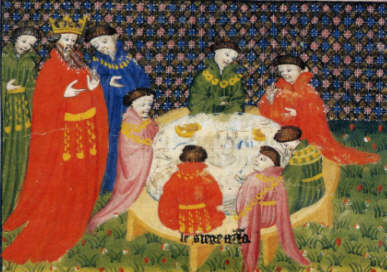
Riding into the Great Hall on his huge green horse, the visitor, clad in green and of immense size, seems to impersonate the superlative itself. This Green Knight surely must have given all the guests and occupants of Camelot a fright, especially as he seems to have come to the castle with a purpose: “Þis haþel helde3 hym in and þe halle entres, / Driuande to þe he3e dece, dut he no woþe” (“The man came forward and entered the hall, making for the high table, regardless of danger”, l. 221-22). The Green Knight immediately directs himself to the leader, and although he does not know exactly who that is, he is wise enough to ride up to the dais. Here one can find another valid reason for the absence of the Round Table. It would have made it more difficult for the Green Knight to find King Arthur and it would have made a far less spectacular sight to see the impressive stranger circling a round table. Figures 2, 3 and 4 will illustrate this. Figure 2 is a fifteenth-century illustration which shows several knights seated at a round table when King Arthur, Sir Gawain and Sir Lancelot enter the Great Hall.
Figure 2:
The round table: Tristanroman. “Folio 233r” of Codex 2537s. 15th century.
Figure 3 is an illustration from the poem SGGK in the fourteenth-century manuscript Cotton Nero X.a. It depicts two separate scenes in the poem, namely the acceptation of the Green Knight’s proposal for a Christmas game as well as the beheading of the same character by Sir Gawain. The Green Knight is seated on his horse in front of the high table, behind which King Arthur, Queen Guinevere, Sir Gawain and Sir Agravain can be seen.
Figure 3:
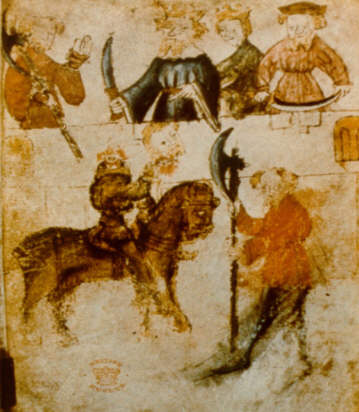
The dais: Sir Gawain and the Green Knight. “Folio 90b” of MS Cotton Nero A.x. 14th century.
Figure 4 shows a late fourteenth-century illustration on which Galahad has just entered the Great Hall where dinner is being served on a round table with an opening in the centre. It becomes clear here that a table seating as in Figure 2 does not give all the diners a clear vision onto the persons who have just entered the Great Hall, nor would they have had a completely free path towards for example the king. The round table with the opening as in Figure 4 already seems a much better option, although it does not seem likely that a knight on a horse could manage to ride into the middle of the table. The table-seating which has been used by the Gawain-poet indeed seems to be the perfect choice for the situation in SGGK. The open space between the side tables and the high dais serves as a red carpet which leads the Green Knight straight into the king’s arms.
Figure 4:
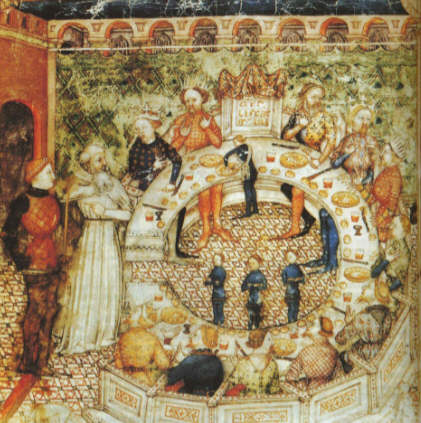
The round table with an open centre: La Queste del Saint Graal. “Folio 3” of MS 343. 14th century.
While the knight advances to the high table, he is being closely watched by everyone present: “Al studied þat þer stod, and stalked hym nerre / Wyth al þe wonder of þe worlde what he worch schulde” (“All who were standing there watched him intently, and cautiously walked closer to him with the greatest curiosity as to what he would do”, l. 237-38). The mentioning of ‘standing’ and ‘walked’ is more significant than it seems at first sight. Earlier on in the story, the noble guests were already seated at the high table, and most probably so were the guests who were allotted a seat at one of the side tables. It is stated specifically in the poem that “to answare wat3 ar3e mony aþel freke, / And al stouned at his steuen and stonstil seten / In a swoghe silence þur3 þe sale riche” (“many a noble knight was afraid to reply, and all were stunned by his words and sat stock-still in a dead silence throughout the royal hall”, l. 241-43). This picture of the Great Hall in which everyone is seated is intensified in the following lines: “Þe renk on his rouncé hym ruched in his sadel, / […] / […] for to wayte quo-so wolde ryse” (“the man on horseback twisted himself in his saddle, […] to see who would rise”, l. 303 and 306). These sentences, however, do not enhance the understanding of the lines referring to the people who are standing. The only person to be standing could have been King Arthur, because he cannot sit still for long. This notion is intensified by the fact that the Green Knight does not immediately spot the king on the dais, which normally should pose no problems, as King Arthur would probably be dressed more splendidly than any of the other diners, or would wear another token of his power. It would, however, not be fitting for a king to walk up to a stranger to take a better look at him, as some people are reported to do in the poem. Therefore, these persons most probably are the waiters who have just finished serving the food.
The Green Knight requests to speak to “þe gouernour of þis gyng” (“the ruler of this company”, l. 225), and after the first astonishment has worn off, Arthur makes himself known to the man. Although the king might be surprised or even scared, his sense of hospitality never leaves him. He behaves according to etiquette and says: “Li3t luflych adoun and lenge, I þe praye, / And quat-so þy wylle is we schal wyt after” (“Be so good as to dismount and stay with us, I beg you, and whatever your pleasure is we shall learn it later”, l. 254-55). A host “should be courtly and liberal, and receive people well, and be as nice and courteous as possible to friends and strangers” (Putter 1995, 51). Camelot is known to welcome strangers, especially during holidays. The Green Knight, however, does not return King Arthur’s good manners. He refuses the offer and immediately informs all the diners of his motives for having come to Camelot. The man does not have time “for hospitality and its rituals” and defies “the rules of hospitality that seek to convert the stranger/enemy into the guest” (Putter 1995, 88). The Green Knight “is not hampered by the restrictions of ritualised politeness,” and the Gawain-poet illustrates this by refusing to let the stranger fall in with Arthur’s hospitality (Nicholls 1985, 115). Accepting King Arthur’s proposition and delaying his game would endanger the knight’s plans for the following year. King Arthur’s request sets hospitality against the refusal of it, and as such the rules of courtly etiquette are reconfirmed to the audience of the Gawain-poet.
In the story discussed here, the Green Knight decides to express his wishes rather than to involve himself with protocol. Under the proper circumstances “the guest does not contradict the host in his own house. […] To do what the host wanted was a fundamental point of courtesy,” and the Green Knight acts in the exact opposite way (Nicholls 1985, 115). The unusual behaviour of this stranger might remind the reader of the actions of Perceval, a hero of Chrétien de Troyes’ making. Perceval rides into the Great Hall when King Arthur and his knights are dining. He rides up to the dais and greets the king. King Arthur is deep in thought, and does not answer straight away, which enrages Perceval. Thereupon, the boy insults the king, something which the Green Knight also does, as one can read further on. Aroused from his daydreams, King Arthur asks the boy to dismount, which he declines to do (ed. Bryant 1982, 11-12). It becomes clear here that both visitors to Camelot lack good manners, and especially in SGGK, the actions of the stranger clash with the well-behaved audience. It must be noted, however, that the behaviour of the Green Knight seems to be intentional, whereas Perceval does not know any better. He is as yet untutored in knighthood.
In this poem, the Green Knight follows his own desires rather than protocol. The knight wishes to play a Christmas game, in which a volunteer may strike off his head with the axe he has brought. When nobody replies to this proposition, as everyone is still overcoming the shock of the apparition’s entrance and subsequently his gothic idea of a game, the Green Knight gets enraged and starts to rant at the court which he just before complimented. This infuriates everybody on the receiving end of the insults, but King Arthur is the first to rush towards the stranger. Moments later, while both the Green Knight and the king prepare the beheading, Sir Gawain addresses King Arthur in an attempt to save his leader’s life. Spontaneity, however, is overruled by the courtly protocol, and Sir Gawain cannot act before asking permission to rise:
‘Wolde 3e, worþilych lorde,’ quoþ Wawan to þe kyng,
‘Bid me bo3e fro þis benche and stonde by yow þere,
Þat I wythoute vylanye my3t voyde þis table,
And þat my legge lady liked not ille,
I wolde com to your counseyl before your cort ryche (l. 343-47).
[If you, my honoured lord,’ said Gawain to the king,
‘would command me to quit this seat and stand by you there,
so that without discourtesy I might leave this table,
and provided that my sovereign lady would not be displeased,
I would come to consult with you in the presence of your noble court.]
The noble knight continues his speech by saying that he believes it wise to exchange places with the king, as he would not be missed as much as King Arthur or any other knight when by any chance the Green Knight will survive the blow and return one to his assailant. After this proposal has democratically been approved by all the nobles, “Þen comaunded þe kyng þe kny3t for to ryse; / And he ful radly vp ros, and ruchched hym fayre, / Kneled doun before þe kyng, and cache3 þat weppen” (“then the king commanded the knight to rise from the table; and he promptly arose and courteously made ready, knelt down before the king and took the weapon”, l. 366-68). After the rules of the game have been clarified, Sir Gawain fulfils his part of the agreement: he beheads the Green Knight. This does not kill the stranger, but no one would have expected that anymore.
The first part of the exchange of blows had to be performed in order to qualify the event as an adventure, and accordingly to enable the continuation of the New Year’s Day dinner. A more gruesome pastime could hardly have been imaginable. The sight of the headless, but sprightly knight probably spoiled the appetite of many diners: “He brayde his bulk aboute, / Þat vgly bodi þat bledde; / Moni on of hym had doute” (“He twisted his trunk around, that gruesome bleeding corpse; many were afraid of him”, l. 440-42). This, however, is not the worst. The Green Knight has not had his last say, and in order to address the right person “þe hede in his honed he halde3 vp euen, / Towards þe derrest on þe dece he dresse3 þe face” (“he actually held up the head in his hand, turning the face towards the greatest nobles on the dais”, l. 444-45). Sir Gawain has seated himself at the high table again, and the stranger has to inform the knight of his whereabouts. With the last words “come, oþer recreaunt be calde þe behoues” (“Come, or you are bound to be called a coward”, l. 456), the Green Knight leaves the Great Hall and its occupants behind.
Everyone is shaken by the short but violent sojourn of the stranger, but King Arthur has to rise above that:
Þe kyng and Gawen þare
At þat grene þay la3e and grenne;
3et breued wat3 hit ful bare
A meruayl among þo menne (l. 463-66).
[The king and Gawain then
laughed at the green man, smiling broadly;
yet amongst the people there it was openly
spoken of as a marvel.]
The host of the festivities has to set the example, and therefore treats the happenings as something comical. The joyous atmosphere left the Great Hall the moment the Green Knight appeared, and although everyone tries their best to revive the happiness, it only survives “as an emotion that is ‘made’” as is shown by the behaviour of King Arthur and Sir Gawain (Putter 1995, 75). They pretend to be unaffected by the marvel which has just occurred in front of their eyes, whereas everyone else still discusses it.
King Arthur’s behaviour, however, is necessary, because as a host one should “toon je gasten een opgetogen gelaat, want een opgewekte gastheer vervolmaakt de vreugde” (Meder 1988, 92). The guests soon follow the king’s example. The adventure indeed was marvellous, but the rediscovery of the food displayed on the tables eventually invokes the realisation that life goes on. After all, food and laughter are the perfect remedy against the pain and fear which can overcome someone during such a dismal moment as the Green Knight’s presence. Therefore, King Arthur says to Sir Gawain:
‘Never þe lece to my mete I may me wel dres,
For I haf sen a selly, I may not forsake.’
[…]
Þenne þay bo3ed to a borde þise burnes togeder,
Þe kyng and þe gode kny3t, and kene men hem serued
Of alle dayntye3 double, as derrest my3t falle.
Wyth all maner of mete and mynstralcie boþe,
Wyth wele walt þay þat day (l. 474-75 and 481-85).
[None the less can I properly betake myself to my meal,
for I have seen a marvel, I cannot deny it.’
[…]
Then both men sat down to table together,
the king and the good knight, and were promptly served
a double portion of every delicacy, as the most noble should rightly be.
With all sorts of food and all kinds of music and song as well,
they passed the day pleasantly.]
Here, it seems as if King Arthur and his knights hardly are stirred by the adventure. William R.J. Barron commends in his edition of SGGK, that the arrival of the Green Knight merely “fulfill[ed] Arthur’s expectations, and his role as challenger of the round table is formulaic” (1974, 6). After all, King Arthur was waiting for an apparition, adventure or wonder to visit him. This does not mean, however, that everyone in the Great Hall was ready for the Green Knight. Not every one is used to supernatural creatures like the stranger. After all, as William R.J. Barron wonders, what are the diners “to expect of a character quite outside their familiar experience, neither knight nor supernatural creature but a fusion of both?” (SGGK 1974, 7). They all might have known that an adventure was to arrive, but that does not mean that they had already read the scenario.
One could conclude from the information found in the first fitt that dinner and food function here as elements of joy and mirth. A perfect picture of Camelot and its inhabitants would portray happy people in a warm and intimate atmosphere, and in this section of SGGK, food always is connected to happiness. Food is a part of all the joyful festivities and the author’s vivid description of this makes the difference between the dinner scene and the arrival of the Green Knight seem all the greater. The first topic which I have discussed, the dinner traditions at Camelot, depicts a near perfect world in which food plays a central role. King Arthur’s refusal to eat, however, invokes the temporary ruin of the feast. Food no longer plays a part here, only traditions surrounding dinner. After the Green Knight’s departure, King Arthur tries to restore the previous atmosphere of the Christmas dinner, and only succeeds with the help of food. It also has become clear from this fitt that a perfect dinner goes hand in hand with good manners and etiquette. King Arthur’s court, after all, “gillt allgemein als der Ort der guten costumes” (Schmolke-Hasselmann 1980, 73). In order to portray this notion in SGGK, “the poet is at pains to stress the excellence and courtesy of Camelot at Christmas time. […] The impression that we obtain from the description of the Christmas feast is of conventional courtesy and luxury being taken to their highest level” (Nicholls 1985, 116). Eventually, it seems that the use of the correct protocol, combined with the splendid food, has resulted in happy diners.
From Fast to Feast: Hautdesert during Christmas Time
At the end of the first fitt, the performance of the Green Knight does not seem to have affected Sir Gawain even in the slightest way. Once the stranger has left the Great Hall, the festivities continue where they had abruptly come to an end only minutes earlier. Unfortunately, the regained cheerfulness of King Arthur and his knights, whether genuine or pretence, does not survive the transition to the second fitt. Scarcely five lines into this section of the poem, the joyful atmosphere is harshly put to an end by the narrator of the story:
Gawan wat3 glad to begynne þose gomne3 in halle,
Bot þa3 þe ende be heuy haf 3e no wonder;
For þa3 men ben mery in mynde quen þay han mayn drynk,
A 3ere 3ernes ful 3erne, and 3elde3 neuer lyke,
Þe forme to þe fynishment folde3 ful selden (l. 495-99).
[Gawain was happy to begin those sports in the hall,
but do not be surprised if the end should be sad;
for though men may be light-hearted when they have drunk strong drink,
a year passes by very quickly, and never brings back like circumstances,
the beginning is very seldom like the end.]
As soon as the time of jollity, camaraderie and unity has passed, and the seasons have come round in rapid succession, reality replaces wonder. The consequences of the Christmas game finally dawn on everyone. In the first fitt, the audience was shown the function of food and dinner in situations of happiness, wonder and even fear, whereas the second fitt offers a look onto several new situations. At the beginning of this section, the farewell party for Sir Gawain is described, in which grief predominates. The knight then departs on his quest for the Green Chapel, in which he has to endure a fair share of hunger and loneliness. Eventually, Sir Gawain finds himself in a situation in which delight again seems to prevail.
2.1 Sir Gawain’s Preparations for the Quest
Subsequent to Sir Gawain’s encounter with the Green Knight, peace had been restored and the Great Hall had regained the joyous atmosphere which it contained the moment that the dinner was served. Unfortunately, not everything could return to normal, because “[t]ha3 hym worde3 were wane when þay to sete wenten,/ Now ar þay stoken of sturne werk, stafful her hond” (“Though matter for discussion was larking when they went to table, now they are fully occupied with serious business, their hands are cram-full”, l. 493-4). Before the arrival of the Green Knight, everyone had been talking about trivialities, such as the games which had just been played, the food which they would eat and the gifts which they received. The happenings concerning the stranger triggered the realisation that death lingers around the corner. Although no soul dared utter it, everyone must have thought that Sir Gawain would now have to go on a quest from which he would most probably not return. All the wine, beer and good food, however, pressed these thoughts to the background, because all the visitors were “mery in mynde quen þay han mayn drynk” (“light-hearted when they have drunk strong drink”, l. 497). Once the alcohol had its effect, the whole situation was looked upon more positively, and eventually the gruesome Christmas game seemed an innocent pastime and the following New Year’s Day was too far ahead to be worthy of worries.
Carefree, the seasons passed by. During spring, the events were still observed carefully, but by the arrival of summer, everything seemed forgotten. With the arrival of the colder and gloomier autumn, however, everyone regained their senses, and not before long the departure of Sir Gawain became imminent. “3et quyl Al-hal-day with Arþer he lenges; / And he made a fare on þat fest for þe freke3 sake, / With much reuel and ryche of þe Rounde Table” (“Yet until All Saint’s Day he remained with Arthur; and he made a feast on that festival for the knight’s sake, with much splendid revelry of the Round Table”, l. 536-38). A farewell party was organised for Sir Gawain. This feast, however, is practically without food, as it is only mentioned once. All the information which is given, is that everyone has dinner together. All the knights, ladies, the king and the queen are emotional because of Sir Gawain’s departure, and the description of these feelings takes up all the space devoted to the farewell party. The festivities give all the knights and ladies the opportunity to say goodbye to their companion and to take one last good look at him, without running the risk of creating too much sorrow, as the revelry would raise his spirits as well as theirs. Although everyone is sad, they try to hide it from Sir Gawain and pretend to be cheerful. Ad Putter comments on this that “face and feeling in Gawain […] are not always identical,” as was already the case at the final dinner scene in the first fitt, when the dinner guests began to regard the actions of the Green Knight as fictive (1995, 79). It becomes clear here that “joy is […] not a romantic ‘spontaneous overflow of powerful feelings’. […] It is a quality that can be acted to cover up an inner turmoil” (Putter 1995, 73). In Chrétien de Troyes’ work Yvain, joyfulness is looked upon in the same way. It can be read there that it is allowed to fake happiness: “[S]uch deceit is honorable. Joy is part and parcel of the honour due to the guest” (Putter 1995, 73). It seems as if both Yvain and SGGK can in this case be looked upon as a practical extension of the theoretical courtesy books. In the Gawain-poet’s work, this cheerful pretense is put up to prevent Sir Gawain from losing courage when seeing how distressed everyone is, and the dinner is in service of this good cause. The knight, however, seems eager to go on the quest for the Green Chapel, “for after mete with mourning he mele3 to his eme, / And speke3 of his passage” (“for after dinner he spoke with concern to his uncle, and talked of his journey”, l. 543-44). Concerned though cheerful he tells everyone that he will depart the following morning.
Once everyone happily took part in the Christmas games, and even the wondrous Green Knight had been looked upon with mirth, but now that everyone realises what has come of it, dissension is rife. All are convinced that this quest will be Sir Gawain’s last, and many disapprove of King Arthur’s custom as talk spreads of what success could have been Sir Gawain’s had he been a duke or a leader:
And so had better haf ben þen britned to no3t,
Hadet with an aluish mon, for angarde3 pryde.
Who knew euer any kyng such counsel to take
As kny3te3 in cauelacioun3 on Crystmasse gomne3! (l. 680-83)
[And he had better have been so than be destroyed utterly,
beheaded by an elvish man because of excessive pride.
Who ever knew any king to take such counsel
as knights give in quibbling over Christmas games!]
Eventually, everyone feels guilty for having agreed to letting Sir Gawain strike the first blow, which will send him off to his own grave. They seem to forget, however, that it could have been their king in this awkward situation, had it not been for Sir Gawain who persuaded all to let him play the game instead. Their emotions seem to turn everything around. The knights and ladies start to doubt everything they normally believe in: their pride in the court, their king, their prowess and their traditions. In order to illustrate this sense of confusion, the Gawain-poet seems to have narrowed down the description of the farewell party to create room for a description of the people’s emotions. Food and dinner do not play a part anymore, nor does comfort, because a joyful dinner stands for unity and sociability, which Camelot seems to have lost by the departure of Sir Gawain.
2.2 The Quest for the Green Chapel and the Arrival at Hautdesert
On the day after the farewell party, which took place on All Saints Day, Sir Gawain sets out on his quest for the Green Chapel. After an elaborate description of his armour, he departs from the Great Hall in a manner similar to that of the Green Knight: “He sperred þe sted with þe spure3 and sprong on his way, / So stif þat þe stond-fyr stroke out þerafter” (“He set spurs to the horse and sprang on his way, so vigorously that sparks were struck from the stones behind him”, l. 671-72). He has to travel for weeks on end without gaining any information concerning the whereabouts of the Green Chapel. During his journey, many adventures present themselves: “Sumwhyle with worme3 he werre3, and with wolues als, / Sumwhyle with wodwos þat woned in þe knarre3” (“Sometimes he fought with dragons, and with wolves also, sometimes with forest trolls, who lived in the rocks”, l. 720-21). At King Arthur’s court, Sir Gawain has had a pretty easy job accepting the challenge, and was “serued of alle dayntye3 double” as a reward for this. Now that the real adventure has arrived, he no longer receives a reward for the hardship he endures. In fact, to preserve his strength, the knight has to keep warm and well-nourished, which is practically impossible to put into practice as the weather worsens and food and shelter are scarce. “Oft leudle3 alone he lenge3 on ny3te3 / Þer he fonde no3t hym byfore þe fare þat he lyked” (“Often, companionless, he spent the night alone where he found no food to his liking set before him”, l. 693-94). During this part of the second fitt, there are no other references to food, neither to the abundance nor to the lack of it. The only exception is the mentioning of the creatures which Sir Gawain fights, and these might have been edible. The lack of references to food, however, perfectly befits the situation. At the beginning of the poem, food and dinner was always mentioned in the presence of happiness, and, as is seen in the scene of the farewell party, the amount of references diminished when the atmosphere became heavier and the jollity faded away. It is therefore not surprising that food is hardly mentioned during Sir Gawain’s search for the Green Chapel. The knight can now show his true feelings as there is no one around for whom he has to pretend to be cheerful. At the moment loneliness, cold and a longing for the luxurious courtly cooking are the only feelings which Sir Gawain experiences.
The lack of food and the feeling of hunger form the clear opposite of the abundance of food at Camelot. Accordingly, this can also be said of the atmosphere at both locations: “The rich indoor revels […] are effectively alternated with cruel winter realities without, and so is the gay fellowship indoors with Sir Gawain’s stark loneliness as he goes by desolate crags to seek his death” (Loomis 1959, 539). Sir Gawain’s hardship is a result of the gruesome Christmas game, of King Arthur’s “no adventure-no dinner custom”. The results of this custom can also be regarded as a way of thanking for all the luxury which King Arthur and his men would otherwise take for granted. The adventures serve as Camelot’s fast which either precedes or follows a splendid feast. It seems as if the knights are being purified by their quests for the unknown. Only a year ago, Sir Gawain was celebrating with all the other knights, his king and his queen in the Great Hall, when “Þe fest wat3 ilyche ful fiften dayes”, and now it seems that the cold reality of outdoor life has harshly woken him up from that dream. The quest for the Green Chapel shows him what life can also be like.
In the description which the Gawain-poet gives of the seasons between the Christmas festivities at Camelot and Sir Gawain’s journey, the opposite in the description of food and dinner as opposed to the New Year’s Day dinner trickled through already: “After Crystenmasse com þe crabbed lentoun, / Þat frayste3 flesch with þe fysche and fode more simple” (“After Christmas there came meagre Lent, which tries the flesh with its fish and plainer fare”, l. 502-03). During the summer months, there would have been more food, hopefully so much that people could hoard enough to get through autumn and winter, in a similar way as the previous summer had assured all the occupants of Camelot of a plentiful Christmas dinner. Knights-errant, however, travel light, and therefore our Sir Gawain has to rely on his own hunter’s instinct, helpful farmers or his hunger for adventure to guide him through the wilderness. Johanna Maria van Winter argues that the body of the medieval man had adapted to the unequal availability of nourishment. She says that it is “aan te nemen dat hun spijsvertering in zoverre leniger was dan die van ons, dat zij langere tijd heel weinig konden eten en dan opeens bij een feestmaal buitensporig veel” (1976, 26). Unfortunately, hardships such as Sir Gawain’s were not unusual.
Something which seems rare during Sir Gawain’s quest for the Green Chapel is hospitality, and this again is closely linked to food. Here one can find another opposite of the proceedings at Camelot. Even though the Green Knight entered the Great Hall uninvited, King Arthur took him in with all due respect, whereas the Gawain-poet does not mention any dwelling in which Sir Gawain can take refuge. The wilderness “appears in courtly romance as a zero-point of hospitality, a place of savageness, disorder, and uncouthness,” and as such the opposite of it seems all the more perfect and attractive (Putter 1995, 52). This could exactly be the reason why the Gawain-poet has chosen to make room for a description of the knight’s suffering. According to Christian Rohr, there should “eine längere Zeit der Besinnung und des Fastens auf Weihnachten und Ostern hinführen,” and as it is close to Christmas Day, Sir Gawain surely is fulfulling his Christian duties where this aspect is concerned (Rohr 2002, 39).
On Christmas Eve, the knight still is clueless as far as the Green Chapel is concerned, and he prays to Mary to help him find a dwelling where he can spend Christmas. Soon after, his prayers are answered when he stumbles upon “[a] castel þe comlokest þat euer kny3t a3te” (“the fairest castle that ever a knight owned”, l. 767). His description of the castle might remind the audience of a certain tradition portrayed at courtly dinners. Most feasts, namely, “contained some elaborate intermissions – the famous entremets, the symbolically significant decorations and entertainments” (Brewer 1997, 132). Among the decorations sometimes were statues which were erected on the dinner tables in the image of a swan, peacock or a castle. According to Derek Brewer, “the Gawain-poet refers in SGGK to such things indirectly when he remarks on the beauty of the white towers and pinnacles of the castle that seemed cut out of paper” (1997, 134). This description of the fair dwelling is only the beginning of a more active role for food and dinner, which is invoked by Sir Gawain’s happiness for finally arriving at a safe haven.
The occupants of the castle immediately receive the knight with the greatest courtesy. According to many medieval books which discuss good manners, a guest should be greeted politely and as quickly as possible, which is exactly what the owner of the castle, Sir Bertilak, does. He “hastens to meet his guest and greets him while Sir Gawain politely thanks the host” for taking him in as if he has returned home (Putter 1995, 69). One should note that Sir Gawain immediately both behaves and is treated as a guest, which greatly contrasts with the scene surrounding the Green Knight. It should, however, be taken in mind here that Sir Gawain is not, as opposed to the Green Knight, a monstrous appearance, which is also shown by the huge difference in the behaviour of both (uninvited) guests. Sir Gawain is very courteous when he arrives at the castle. Instead of riding into the Great Hall without any given invitation, as the Green Knight did in Camelot, he first asks the master of the house, or rather the porter, for shelter. This is proof of the knight’s good manners, because, according to courtesy books, “als je voor iemands deur staat, dan moet je niet onverwachts naar binnen gaan zonder je aanwezigheid kenbaar te maken, dat zou incorrect zijn” (Meder 1988, 91). Sir Gawain’s knowledge of courtly etiquette might be his ticket to a decent meal. The knight is, after all, by many looked upon as a paragon of courtliness.
2.3 Sir Gawain and Sir Bertilak Celebrate Christmas
During the remainder of the second fitt, the Gawain-poet depicts the Arthurian knight’s stay at Sir Bertilak’s castle Hautdesert. After a warm welcome from the lord of the manor and his servants, Sir Gawain is served an individual meal in front of a fireplace. It was not unusual for meals to be “eaten in chambers, but to begin with this was the exception to the general practice of meals being eaten by the household sitting together in the hall” (Girouard 1978, 45). However, it can be read in the text that “Bi þat þe diner wat3 done and þe dere vp, / Hit wat3 ne3 at þe niy3t ne3ed þe tyme” (“By the time the meal was finished and the prince had risen, night-time had drawn near”, l. 928-29), and therefore one could assume that the knight had probably just missed the dinner in the Great Hall. Sir Gawain’s private dinner is described very thoroughly by the author of the poem:
And he sete in þat settle semlych ryche,
And achaufed hym chefly, and þenne his cher mended.
Sone wat3 telded vp a tabil on treste3 ful fayre,
Clad wyth a clene cloþe þat cler quyt schewed,
Sanap and salure and syluerin spone3.
Þe wy3e wesche at his wylle, and went to his mete.
Segge3 hym serued semly inno3e
Wyth sere sewes and sete, sesounde of þe best,
Double-felde, as hit falle3; and fele kyn fische3,
Summe baked in bred, summe brad on þe glede3,
Summe soþen, summe in sewe sauered with spyces,
And ay sawses so sle3e þat þe segge lyked.
Þe freke calde hit a fest ful frely and ofte
Ful hendely, quen alle þe haþeles rehayted hym at one3
As hende:
‘Þis penaunce now 3e take,
And eft hit schal amende.’
Þat mon such merþe con make,
For wyn in his hed þat wende (l. 882-900).
[And he sat down in that rich and handsome seat,
and warmed himself quickly, and then his spirits rose.
Straightway a table was set up on trestles very neatly,
covered with a clean cloth, pure white in colour,
and an overcloth, with a salt-cellar, and silver spoons.
At his good pleasure the knight washed his hands and sat down to his meal.
He was most handsomely served
with various excellent broths, seasoned in the best way,
in double portions, as was fitting, and many kinds of fish,
some baked in pie-crust, some grilled on the embers,
some poached, some in stew flavoured with spices,
and all with sauces so skilfully made as to please the knight.
The knight very readily and repeatedly called it a feast,
most politely, whereupon, with equal courtesy, all the company
as one man pressed him:
‘Accept this penitential fare now,
and later it will improve.’
The knight was very merry
because of the wine which went to his head.]
Although this quotation only concerns Sir Gawain and not the host, it does become clear that “the ceremony of serving up meals centred round the lord, and could operate even when he was eating on his own” (Girouard 1978, 23). The first action during this dinner is the same as that during the Christmas festivities at Camelot: the washing of one’s hands. “The particularisation of it at Hautdesert seems to be a traditional signal that the meal was passed with full attention to courteous behaviour,” and therefore it should make our knight feel all the more at home (Nicholls 1985, 127). Especially after his arduous journey, he is well deserving of this splendid dinner.
The dinner itself seems to be described by the Gawain-poet even more elaborately than the meals which are served at Camelot. This is probably done to emphasise the difference between the lack of food during Sir Gawain’s journey and the abundance of it at both Camelot and Hautdesert. Besides that, it could also function as a belated reward for the adventures which Sir Gawain endured out in the wild. Another thing which catches one’s attention here is the fact that the Gawain-poet so explicitly mentions “fische3” as the main course during the knight’s dinner. This is not without reason, as the day of Sir Gawain’s arrival at Sir Bertilak’s castle is not just any day. It is “Christmas Eve, by ecclesiastical regulation an abstinence and not a feast day,” and as such, Christians are not allowed to consume meat (Savage 1952, 537). Being the day before Christmas, it was “part of the traditional vigil before the feast,” to abstain from certain types of food (Brewer 1997, 137-38). It is known from medieval cookbooks that “the aristocracy observed fasting strictly […]. The most basic dishes were given in fast-day as well as normal-day versions,” although the cook at Hautdesert has prepared the fast-day dishes with feast-day splendour (Bynum 1987, 41). The dishes are of “such variety and such excellence of cuisine [and] prompt our hero, ever renowned for his courtesy, to protest that he has feasted rather than fasted, but his host refuses to receive the compliment and reminds him that he is tasting but penitential fare” (Savage 1952, 537). This politeness of both Sir Gawain and his host’s entourage causes the meal to seem even more luxurious. Besides, Camelot and its famous knights seem to have quite a reputation at Hautdesert, and therefore the host and his servants might expect Sir Gawain to be served more exquisitely at King Arthur’s court, even on a fast day. Although “the food may be technically that of the fast, […] the concept is rather that of polite self-depreciation” (Brewer 1997, 140). The household exercises good manners by adopting this modesty.
Sir Gawain uses his good manners to compliment his host. In courtesy books, the following rule can be found: “Als je van iemand een geschenk hebt ontvangen, moet je hem altijd dankbaar zijn; prijs de geschenken en de gever” (Meder 1988, 91). After the ordeal which Sir Gawain had to go through, even a fast-dinner seems very welcoming to him. His relief for finally having come upon a dwelling shines through in his thankfulness to the host and his servants. It is interesting to note, however, that fast-meals such as the one which is served at Hautdesert do “not bother Arthur’s court as far as we are told” (Brewer 1997, 138). The Gawain-poet does not mention such a meal anywhere else in the poem. However, the results of King Arthur’s special custom form a fast in itself, as has already been mentioned before in this paper. H. Bergner says that “the portrayal of all things private is foreign to the Arthurian court in SGGK because action is there bound to the official knightly code,” and therefore protocol seems to prevail at Camelot, whereas food itself adopts a more significant role during Sir Gawain’s private dinner (1986, 411).
As soon as Sir Gawain has finished his meal, the servants request his name. They must already have guessed from his attire that he is a knight, but once they find out that he is a knight of the Round Table, they expect him to perform the protocol to perfection during his stay at Hautdesert: “Now schal we semlych se sle3te3 of þewe3 / And þe teccheles termes of talking noble” (“Now we shall have the pleasure of seeing masterly displays of good manners and hearing the polished phrases of courtly discourse”, l. 916-17). Shortly after dinner, Sir Gawain is reunited with Sir Bertilak, and he is introduced to the lady of the house, who is accompanied by an elderly woman.
Þay tan hym bytwene hem, wyth talkyng hym leden
To chambre, to chemné, and chefly þay asken
Spyce3, þat vnsparely men speded hom to bring,
And þe wynnelych wyne þerwith vche tyme (l. 977-80).
[Placing him between them, they conducted him,
conversing together, to their sitting room, to the hearthside,
and at once call for sweetmeats, which servants hasten to bring them without stint,
and, with each service, cheering wine as well.]
Again, it becomes clear here that Sir Gawain has arrived at a safe haven where he can relax and enjoy himself.
The following day, the knight spends Christmas in the joyful company of Hautdesert’s occupants. Dinner during that evening is served in the Great Hall, and this time the knight does not lack company:
Boþe at mes and at mele messes ful quaynt
Derf men vpon dece drest of þe best.
[…]
Gawan and þe gay burde togeder þay seten,
Euen inmydde3, as þe messe metely come,
And syþen þur3 al þe sale, as hem best semed,
Bi vche grome at his degré grayþely wat3 serued (l. 999-1000 and 1003-06).
[Both at dinner and at other meals, willing servants
set out upon the high table dishes of the best, skilfully prepared.
[…]
Gawain and the fair lady sat together,
right in the center, where the dishes came first, as was proper,
and then were served throughout the hall as seemed most fitting to the company,
until every man had been duly served according to his rank.]
The table seating is similar to that at Camelot, and again, Sir Gawain is placed beside the lady of the house. Sir Gawain spends four days in similar fashion, in the lap of luxury and cheerfulness. Derek Brewer concludes from this that the festivities at Bertilak’s castle only last for that number of days, opposed to the two-week-feasting at Arthur’s court (Brewer 1997, 137). It should be noted here, however, that Sir Gawain most probably arrived at the castle halfway through the festivities, just as the festival at Camelot proceeded into its second week around Christmas Eve. The festival at Hautdesert “is characterized by the same external signs of joie seen at Camelot: mirth, games, music, dances, wine, and feasts which last for a number of days” (Newhauser 1991, 466). During these days, the dinners surely contribute to the exuberance, and as such they greatly differ from the fast-meal which Sir Gawain enjoyed a few days earlier: “The feast exemplifies and emphasises the goodness of material existence enjoyed in good society: the fast points out the shortcomings of material and social goods, their carnal selfishness. […] They differ also in that the feast emphasises the group. The fast is more normally solitary, and certainly makes group feeling hard to attain or achieve” (Brewer 1991, 26).
During Sir Gawain’s fourth day at Hautdesert, he realises that the revelry cannot last forever. He can no longer postpone the progression of his journey in search for the Green Knight’s abode. Sir Bertilak, however, has knowledge of the whereabouts of the Green Chapel, and persuades the knight to remain in his company for several more days, because the goal of Sir Gawain’s quest can be reached within several hours. The knight happily gives in to the request, because “to do what the host wanted was a fundamental point of courtesy,” a point which the Green Knight very actively opposed a year earlier (Nicholls 1985, 115). This makes clear that Sir Gawain is the perfect guest, something which is emphasised even more by the fact that the Green Knight is the complete opposite. He seemed to make a sport of acting the opposite of the usual etiquette.
By way of a belated Christmas game, the host wants to make an agreement with Sir Gawain to exchange winnings during the following day. Sir Bertilak himself will go hunting, whereas Sir Gawain has to remain at the castle, for which the host gives the following reasons:
’For 3e haf trauayled,’ quoþ þe tulk, ‘towen fro ferre,
And syþen waked me with, 3e arn not wel waryst
Nauþer of sostnaunce ne of slepe, soþly I knowe.
3e schal lenge in your lofte and ly3e in your ese
To-morn quyle þe messequyle, and to mete wende
When 3e wyl’ (l. 1093-98).
[‘As you have had a hard journey coming from afar,’ said the lord,
‘and then stayed awake all night with me, you are not yet fully refreshed
either by food or sleep, I know quite well.
You shall stay in your room, and lie at your ease
tomorrow morning until time for Mass, and come to table
whenever you like’.]
Sir Gawain cannot deny the fact that he has still not overcome the effect of his journey, and so he agrees to the proposition, after which the lord of the house says: “Who brynge3 vus þis beuerage, þis bargain is maked” (“’If someone will bring us the drink to seal it, the bargain is made’”, l. 1112). In accordance with this, a merry evening in which the wine richly flows seals the second fitt, and at the same time announces the third.
The analysis in this chapter shows that the mention or availability of food and dinner in the second fitt of SGGK is connected with the atmosphere which is interwoven with the storyline. Each change of emotion is reflected in the depiction of the dinners. At the beginning of the fitt, Camelot is filled with grief, because Sir Gawain is about to leave. Automatically, the Gawain-poet hardly concerns himself with food, dining or dinner customs anymore, except when the sorrow grows out of proportion and food and drink are used to invoke happiness. The reason for the absence of food during Sir Gawain’s quest is totally different. The knight’s failure to find the Green Chapel lowers his spirits, which is enhanced by the lack of food and the bad weather. The lack of happiness in the first half of the second fitt has its effects on the amount of lines concerned with dinner. Luckily, salvation is near, and Sir Gawain finds shelter in the seemingly friendly Hautdesert. This event gives food a second chance. In Sir Bertilak’s manor, the knight’s spirits regain their former state of jollity, and immediately this is reflected in the number of dinner scenes. The presence of hospitality and courtly etiquette also has its effects on the description of meals. During the knight’s stay at Hautdesert, he “actively demonstrates a consciousness of his place in its conviviality,” for which he is rewarded with food, camaraderie and a bed (Newhauser 1991, 467).
The Exchange of Winnings: Sir Gawain’s Test
In the last few lines of the second fitt, the Gawain-poet describes Sir Bertilak and Sir Gawain during a joyful evening in front of the fireplace, while the wine freely flows. Amid this cheerfulness the men agree on playing a game. The following day, the host will go out hunting, whereas Sir Gawain will stay at castle Hautdesert, and after a long day the two parties will exchange whichever winnings they have gained. This agreement is to be remade twice more during the following days, which results in a very elaborately described three-day hunt. Due to this change of circumstances, the dinner scenes in this section of the poem are again of another nature than the scenes which have been discussed up to now. The making of the agreement, the fulfillment of the pact and the exchange of winnings itself are all accompanied by plenty of food and wine. Although there are quite a few dinners and meals situated around the hunting scenes, food has been allotted a considerably different and especially smaller role in the third fitt than in the first and second sections of the poem. In order to discover the function behind this alteration in the depiction of food and dinner, the third fitt will in this chapter be discussed in detail. In order to get a better grasp at the storyline of the third fitt, and therefore to enhance an understanding of the details which are of special meaning to food and dinner, a summary will first be given:
During the first day of the Exchange of Winnings game, Sir Bertilak spends all day in the forest with his men and his dogs while he hunts for deer. On the second day, the lord and his entourage hunt for a wild boar which they do not manage to catch until late in the afternoon. On the third day, Hautdesert’s occupants hunt for a fox, whose cunning cannot get him safely through the day. Although Sir Gawain does not participate in the hunts, he is very well cared for at the castle. Where this aspect is concerned, SGGK can be compared to Chrétien de Troyes’ Perceval. In Chrétien’s work, Sir Gawain meets a knight in a forest, who invites him to lodge at his castle. The knight will first go hunting in the company of his men, but Sir Gawain is assured that the knight’s sister will in the meantime make him very welcome. The knight and lady’s hospitality, however, later on brings Sir Gawain into difficulties (ed. Bryant 1982, 62). In SGGK, Sir Gawain also is made very welcome by Lady Bertilak. He does not have to accomplish much to obtain his winnings at Hautdesert. Whereas Sir Bertilak hunts for animals in the forest, his wife seems to be hunting for Sir Gawain at Hautdesert, and with her skills of seduction she successfully manages to offer her guest an additional kiss each day, so that Sir Gawain can reward the lord of the house with one kiss on the first day of the Exchange of Winnings game, two on the second, and three on the third. The exact happenings during each day and the clues concerning the function of food and dinner in the poem will be discussed below.
3.1 Day One: Venison, Wine and Courtly Love
During the day of the first agreement, Sir Bertilak fulfils his side of the pact by spending the day hunting deer, while Sir Gawain stays at Hautdesert to rest. Already early in the morning, while it is still dark and Sir Gawain is still enjoying his warm bed, the household prepares everything for the hunt of their lord, who is awake already as well:
Þe leue lorde of þe londe wat3 not þe last
Arayed for þe rydyng, with renkke3 ful mony;
Ete a sop hastyly, when he hade herde masse,
With bygle to bent-felde he buske3 bylyue (l. 1133-36).
[The good lord of that land was not the last
to be ready for riding, with many followers;
when he had heard Mass, he ate a morsel hurriedly,
and to the sound of a horn sped in haste to the hunting-field.]
The rush in which Sir Bertilak and his retainers are becomes very clear here. Rather than being served the meal, it seems as if everyone has to take care of himself this morning, as Sir Bertilak is so eager to proudly present his noble guest with a hunting trophy. He does not rest, nor does he let anyone else rest, before he has procured the meat of the largest animal. In fact, the hunters are after the largest female animal, as the stags and bucks are declared off-limits: “For þe fre lorde hade defende in fermysoun tyme / Þat þer schulde no mon meue to þe male dere” (“For the noble lord had forbidden that anyone would interfere with the male deer in the close season”, l. 1156-57). In his edition of SGGK, Brian Stone comments that this close season for male deer “was 14 September to 24 June, but female deer were hunted from 14 September to 2 February” (177). He does, however, not add the reason for these specific hunting rules. Although the male animals are not harmed, the others are routed. It becomes clear that the large group of hunters and dogs strikes the animals with terror. They flee “doted for drede” (“crazed with fear”, l. 1151) onto the hills.
During the day, however, not only the female deer are worried. Sir Gawain, who is supposed to be relaxing at the castle, is put in an awkward position by the lady of the house. While the lord of the house is busy shooting animals, the lady has taken it upon herself to make her guest feel comfortable, very comfortable. She spends the day hunting for the love of her guest. It can be said that “the questing knight who hunts for the green chapel, […] has become the haunted” (Woods 2002, 217). The lady visits the knight while he is still in bed, which greatly confuses Sir Gawain. The sound of the opening door wakes him, and then he discovers the cause of the noise: Lady Bertilak. It should be born in mind here that “the appearance of the lady in Gawain’s bedroom is a violation […] of the rules of courtesy” (Morgan 1987, 206), and besides that, Sir Gawain also is naked. The knight is therefore embarrassed to see her come into his private lodgings, “to meruayle hym þo3t” (“it seemed to him very strange”, l. 1197). This also becomes clear when he says that he would have more pleasure to talk to her once he has left his bed and is dressed more suitably (l. 1220-21). She, however, wants to try to tempt him into being her lover, so she does not let him leave his bed. Sir Gawain is here torn between his courtesy towards his host, and that towards the lady. Both the knight and the lady behave with all courtesy: “Scho made hym so gret chere, / Þat wat3 so fayr of face; / Þe kny3t with speeches skere / Answared to vche a cace” (“She who was so fair of face behaved most graciously to him; the knight responded to each remark with impeccable replies”, l. 1259-62). This makes it seem as if it is usual for a lady to enter a knight’s bedroom, which, of course, it is not. Sir Gawain’s behaviour here can be compared to that of the deer, an animal which according to Henry L. Savage is “the soul of honor, but elusive, shy” (1928, 13). Sir Gawain also is shy, and tries to behave as honourable as possible towards the lady. As such, he does not condemn her behaviour. Sir Gawain is too occupied with his meeting with the Green Knight to truly understand the meaning of the lady’s behaviour. This possibly also is the reason for the situation where the lady, rather than the knight, begs for a kiss, whereas it should be the other way around, according to Lady Bertilak. Then she kisses him, and Sir Gawain has gained his winning for the day.
The Gawain-poet then describes the Arthurian knight’s breakfast. Unlike Sir Bertilak’s breakfast, Sir Gawain’s meal is consumed after the events in which he gains his winnings. The meal also is considerably more extensive than that of Sir Gawain’s host, who eats a morsel hurriedly, whereas the knight can take his time: “And þenne he meued to his mete þat menskly hym keped, / And made myry al day til þe mone rysed” (“And afterwards [after mass] he went to his meal which, as was proper, awaited him, and made merry all day, diverting himself, till the moon rose”, l. 1312-13). The only similarity with the host’s meal is that both are consumed after the hearing of Mass. The remainder of the day Sir Gawain is entertained by the two ladies of Hautdesert. There are no more details given of Sir Gawain’s day, as the Gawain-poet at this point shifts the perspective to the forest in which Sir Bertilak is still working for his end of the agreement.
At the end of the day, the host has caught many does and deer. His hunting method seems to have been adapted to the behaviour of the female deer. “The hinds and other folly live in herds, and so a whole group can be driven towards the hunters at once” (Rooney 1993, 166), which is exactly what Sir Bertilak and his retainers have done. It should be noted that the hunt for male deer would have to be organised in a totally different manner, as it is “the hart which lives in solitary existence, and so can be hunted alone” (Rooney 1993, 166). A hunt for female deer as such results in a much larger catch, for which Sir Bertilak’s hunt serves as evidence. His retainers “didden hem derely vndo as þe dede aske3” (“had them [the killed deer] cut open neatly as the business should be done”, l. 1327), and the meat was divided under all the hunters and the dogs. Sir Bertilak himself takes some of the best pieces of venison with him to Hautdesert. So, a well-spent first day results in the exchange of one kiss and the meat of a female deer. This trading of goods takes place in the Great Hall of Hautdesert where all the occupants of the castle have been summoned as witnesses. The host is the first to present his winnings to the guest, after which he receives one kiss, as Sir Gawain had an “obligation to repay gifts received” (Mauss 1954, 10). Besides, it also was a case of honour, as a “gift not yet repaid debases the man who accepted it” (Mauss 1954, 63).
All the occupants of Hautdesert then indulge in a hard-earned dinner: “To soper þay 3ede as-swyþe, / Wyth dayntés nwe innowe” (“They went at once to supper, where they had fresh delicacies in plenty”, l. 1400-01). Sir Gawain’s venison most probably will once also become a fresh delicacy at the dinner table. The manner in which Sir Bertilak’s winnings are presented to Sir Gawain confirms this. During the hunt, “a large number of deer are killed, and at the end of the day are ritually cut-up (“broken”) following well-established procedures” (Rooney 1997, 159). When the meat is handed over to the knight, the Gawain-poet refers to it as “venysoun” (l. 1375), a French word which refers to the meat from a deer, rather than to the living animal itself. Sir Gawain says that “here is wayth fayrest / Þat I se3 þis seuen 3ere in sesoun of winter” (“this is the finest kill I have seen these seven years in the winter season”, l. 1381-82). It would certainly be a waste if this “beast of venery” was not eaten, as “a higher prestige or distinction was attached to the pursuit and slaying” of deer, which were “protected by the law that governed the royal forests” (Savage 1928, 2). Therefore, it would be most logical if the venison ended up on someone’s plate, as that would be the best way to make use of this gift.
At the end of the day, Sir Gawain and Sir Bertilak, “by þe chymné in chamber þay seten, / Wy3e3 þe walle wyn we3ed to hem oft” (“they sat by the fireplace in a private room, servants repeatedly bringing them wine” l. 1402-03). Although Sir Gawain was slightly embarrassed by Lady Bertilak’s advances when she entered his bedroom uninvited, he does agree to another exchange of winnings during the following day, and under the same conditions. Then “Þay accorded of þe couenaunte3 byfore þe court alle – / Þe beuerage wat3 bro3t forth in bourde at þat tyme” (“They confirmed the terms of the compact before the whole court – at which point the pledging-cup was brought in amid jesting”, l. 1408-09). This “pledging-cup” also played a part in the making of the agreement the day before, and now it has become clear that by way of tradition wine freely flows when the men make plans. Drinks are brought in to seal the pact, and as such, the wine seems to have a ceremonial role.
It is possible that it is the wine that has made Sir Gawain forget about his encounter with the lady of the house, but there also is another reason for his decision to remain at the castle again the following day while the host goes out hunting. Anne Rooney argues that “Bertilak has offered that he spends time at ease; he has not offered to take Gawain hunting. It would be discourteous to reject what has been offered and ask to join in Bertilak’s sport uninvited” (1997, 158). Therefore, our knight rather takes the risk of being in a difficult position again when he agrees to spend the following day with the lady of Hautdesert.
Although the Gawain-poet does mention several meals throughout this first day of the exchange of winnings, the hunts in the forest and at Hautdesert take up much more space in the poem. Somehow, these scenes also seem to be connected with food: “De nieuwe gewoonte van het eten in paren bracht een samenhang teweeg tussen hoofse maaltijd en hoofse liefde,” which should be taken in mind here (Bumke 1989, 238). During the second fitt, the couple was placed beside each other during the Christmas festivities, where they “burde / such comfort of her companye ca3ten together” (“found such delight in each other’s society”, l. 1010-11). It is possible that Sir Gawain is placed beside the lady of the house during dinners in order to enhance a better outcome during the exchange of winnings. Christopher Dean argues here about Sir Gawain that “at the feast he sits with the wife […] but this is no more than he had done with Guinevere at Camelot” (1971, 3). It should be noted, however, that the description of the feast is a lot more individual at Hautdesert, where Sir Gawain is said to have a conversation with the lady of the house, and they entertain each other as if there is no one else present. The scene at Camelot was more public, and largely focused on the customs, the food and the whole gathering in general. Therefore, one could say that the lady’s temptation of Sir Gawain has already begun during the dinners, of which we see the result during the bedroom scenes.
3.2 Day Two: Assumed Perfection and the Severed Head
The second day of the exchange of winnings seems to pass almost similarly to the first day. Again, the host wakes early and repeats his morning rituals:
Bi þat þe coke hade crowen and cackled bot þryse,
Þe lorde wat3 lopen of his bedde, þe leude3 vchone,
So þat þe mete and þe masse wat3 metely delyuered,
Þe douthe dressed to þe wod, er any day sprenged,
to chace (l. 1412-16).
[Before the cock had crowed and cackled more than three times,
the lord had leapt from his bed, and all his men,
so that the Mass and the meal were duly finished,
and the company bound for the forest, to the hunt,
before the day dawned.]
After some time straying in the woods, the object of the chase is spotted: a wild boar. The difference with the timid deer of the previous day soon becomes clear. The animal “wat3 breme, bor alþer-grattest, / Ful grymme quen he gronyed; þenne greued money, / For þre at þe first þrast he þry3t to þe erþe” (“was fierce, the biggest of boars, terrifying when he grunted; then many men were dismayed, for at the first rush he hurled three of them to the ground”, l. 1441-43). Catching this animal would prove to be far more difficult than catching the deer of the previous day.
Sir Gawain at this moment is still in his warm bed, and again he is visited by Lady Bertilak. The behaviour of the boar seems to reflect the atmosphere in Sir Gawain’s bedroom. The previous day, the knight seemed to be acting similarly to the timid deer. Today, Sir Gawain does not hide from the lady. He does not pretend to be asleep, hoping to find out the reason behind her presence in his bedroom. As soon as the lady enters his room, he greets her, as if he awaited her visit. Like the boar, Sir Gawain faces his pursuer, watches her movements and resists all her attempts to drive him into a corner (Savage 1928, 13). The behaviour of the lady, however, even seems to be a better reflection of the wild boar’s conduct. Alike Sir Gawain, she also has adopted a slightly more aggressive and assertive conduct than the previous day. She seems to have taken it on her “his mode for to remwe” (“to change his attitude”, l. 1475). Firstly, she requests a kiss from him, as that would be usual in polite society (l. 1483). Sir Gawain says that he would rather have her kiss him, as he would not want to force himself on her. The couple then has a conversation in which the lady tries to win Sir Gawain’s love, and the knight tries to make the best of it. He realises that “there is as much danger of too little courtesy by bluntly shunning the Lady’s demand for love as there is of too much by granting it” (McClure 1973, 377). The previous day, Sir Gawain still played along with the game, but now he seems to realise that it takes more to get himself out of the tricky situation. Although he is not so docile anymore, he behaves so courteously that neither of them needs to feel ashamed, “nawþer þay wysten / bot blysse” (“nor were they conscious of anything but contentment”, l. 1552-3). The lady then kisses the knight once more, and leaves his bedroom. Sir Gawain again has breakfast after he has gained his winnings, in this case two kisses: “Then ruþes hym þe renk and ryses to þe masse, / And siþen hor diner wat3 dy3t and derely serued” (“Then the knight bestirred himself and rose to go to Mass, and then their dinner was prepared and splendidly served”, l. 1558-59). The perfection with which Sir Gawain’s breakfast is prepared and served makes it seem as if everything happens according to protocol. It should be noted here that Sir Gawain does not have breakfast by himself, as there is spoken of “hor diner”. The remainder of the day passes similarly to the previous day, as Sir Gawain is again kept company by the two ladies until Sir Bertilak returns from his hunt.
Sir Bertilak in the meantime has faced the wild boar in a one-to-one fight. The animal has the worst of it and is cut up shortly afterwards. This is the second scene in which the Gawain-poet has dedicated room to this practice, and the reason for this might be that it had to be done according to protocol. The author goes to extremes to provide a perfect example of this typical courtly skill. The head of the animal also is cut off, and together with the meat, this is brought back to Hautdesert. The ladies, their entourage and the whole household are again summoned to the hall of the castle to witness the exchange of winnings. Sir Bertilak presents his winnings to the knight. Sir Gawain praises the meat which has been cut from the animal: “such a brawne of a best, […] / […] segh he neuer are” (“a beast with such flesh on it, […] he had never seen before”, l. 1631-32). The head of the wild boar might remind the reader, and Sir Gawain, of a spectacle during New Year’s Day’s dinner at Camelot, where the severed head of the Green Knight had rolled around the Great Hall, and had even spoken to the diners. In the poem, Sir Gawain is said to have “let lodly þerat þe lorde for to here” (“expressed horror at it in order to honour the lord”, l. 1634), but it should be taken in account here that the sight of the boar’s head might also have reminded the knight of what is to come in a few days. Then it is time for Sir Gawain to hand over his winnings to the host, and he twice kisses him courteously. Sir Bertilak then wittily remarks: “3e ben ryche in a whyle, / Such chaffer and 3e drowe” (“You will be rich presently, if you carry on such a trade”, l. 1646-47).
After these events, the assembly gets ready for dinner. This time, the meal is described more elaborately than the one during the previous day, although the emphasis is on the decoration and the revelry rather than on the food itself:
Þenne þay teldet table3 trestes alofte,
Kesten cloþe3 vpon; clere ly3t þenne
Wakned bi wo3e3, waxen torches;
Segge3 sette and serued in sale al aboute.
Much glam and gle glent vp þerinne
Aboute þe fyre vpon flet, and on fele wyse
At þe soper and after, mony aþel songe3 (l. 1648-54).
[Then tables were set up on trestles,
and covered with cloths; next bright lights,
waxen torches, were kindled on the walls;
servants laid and served supper throughout the hall.
Great noise of revelry and merriment arose there
round the fire on the hearth, and, at the supper and afterwards,
there were many splendid songs of various kinds.]
The absence of food, or rather of the description of food does not seem without reason. Sir Gawain is not really in the mood for a feast, as he is distracted from the food and the revelry around him. He is placed beside the lady, and today, he wishes he could have sat somewhere else as he is again torn between courtesy towards her and towards his host.
Such semblaunt to þat segge semly ho made,
Wyth stille stollen countenance, þat stalworth to plese,
Þat al forwondered wat3 þe wy3e, and wroth with hymseluen,
Bot he nolde not for his nurture nurne hir a3ayne3,
Bot dalt with hir al in daynté (l. 1658-62).
[Her behaviour to the knight was so complaisant,
With looks of favour slyly stolen, to please that bold knight,
That he was quite bewildered, and troubled at heart,
But his good breeding prevented him from rebuffing her,
And he behaved with complete courtesy towards her.]
The lady’s behaviour is an embarrassment to Sir Gawain, he feels uncomfortable. He is so occupied with the lady, trying to keep her at a respectable distance without upsetting her, and meanwhile praying that the host will not notice anything odd, that food is not on his mind. In the meantime, it seems as if all the decorations in the dining hall and the entertainment during dinner have to distract the attention from the couple’s struggling.
After dinner, Sir Bertilak summons Sir Gawain to his private room, where “þay drunken and dalten” (they drank and talked”, l. 1668). They agree to another exchange of winnings the next day, but then Sir Gawain suddenly is reminded of his quest for the Green Chapel, and he makes known to Sir Bertilak that he would prefer to leave the following morning. The host, however, convinces him that he will still arrive in time if he departs a day later. A remark which he makes here is a warning to the audience: “I haf fraysted þe twys and faythful I fynde þe. / Now “þrid tyme, þrowe best” þenk on þe morne” (I have tested you twice and I find you trustworthy. Now, “third time pays for all”, remember that tomorrow”, l. 1679-80). The songs, the merriment, noise and the wine create an atmosphere of conviviality, as if all is well. The lord’s hint, however, shows that this is not true. It proves that prudence is called for at Hautdesert. Sir Gawain, however, agrees to spend the following day in the same fashion as the past two days. The host will go hunting, and the knight will take it easy at Hautdesert. This agreement is made again while the men indulge in many glasses of wine. This abundance of alcoholic beverages, which we have seen especially at times when an agreement is made between both men, might be seen as a foreboding for Sir Gawain’s future, partly due to the fact that even slightly being intoxicated is not the best mood during which one should agree on a pact. Sir Bertilak has always behaved very courteously towards Sir Gawain, but it becomes clear here that he might be using alcohol to cover up underlying truths which Sir Gawain as yet is not supposed to know about.
3.3 Day Three: Crafty Cunning and the Green Girdle
On the following morning, which happens to be the last day of the year, Sir Bertilak does not fail to perform the activities which have now become traditional: “After messe a morsel he and his men token; / Miry wat3 þe morning, his mounture he askes” (“After Mass he and his men took a hasty bite; the morning was fine and he called for his mount”, l. 1690-91). Once everyone is ready for action, the lord, his men and his hounds go to the forest, where the dogs soon hit on the scent of today’s hunted animal: the fox. Immediately, the Gawain-poet describes the character of the animal: he cunningly flees in a zigzag, trying to fool the dogs, leading them from side to side (l. 1700). Several times, the fox thinks that he has managed to get away, but then he stumbles upon another group of dogs and hunters, so that he has to choose another path.
Sir Gawain’s attempts to escape the lady’s temptations somewhat resemble those of the fox. The lady has risen even earlier than the previous days, and has dressed herself in most lovely attire, in order to get Sir Gawain to exercise some of his famous love tactics on her. Today, the lady for the first time has to wake the knight. During the first day of the exchange of winnings, he heard her coming into the room, and during the second day he was already waiting for her. Today, he is so fast asleep, troubled by his meeting with the Green Knight, that he does not hear her enter his room (l. 1748). The lady immediately kisses Sir Gawain, and the two then have a pleasant conversation. This talk, however, soon takes a turn for the worst, as “þat princes of pris dpresed hym so þikke, / Nurned hym so ne3e þe þred, þat need hym bihoued / Oþer lach þer hir luf, oþer lodly refuse” (“that noble princess pressed him so hard, urged him so near to the limit, that he must needs either accept her love there and then, or refuse offensively”, l. 1770-72). Sir Gawain is concerned with his courtesy towards the lady, but he also is concerned not to commit a sin and to be a traitor to the lord. Eventually, Sir Gawain says that he does not want a sweetheart at the moment, and so refuses the lady. She is hurt, but she accepts it.
The lady kisses the knight a second time by way of goodbye and wants to leave. Then she suddenly asks Sir Gawain for a gift, a reminder of him. He says that he has not brought anything with him on his quest which would be a worthy gift for her. Lady Bertilak then offers him her ring, and again the knight refuses, this time because he thinks the gift is too precious, as he is already in debt for her kindness and hospitality. Then she offers him her green girdle, but Sir Gawain does not want to accept any gift from her. She tells him that the girdle will protect whoever carries it from mortal danger, with which she finally gets through to him. He thinks that “Hit were a juel for þe jopardé þat hym iugged were” (“it would be a godsend for the perilous adventure which was assigned him”, l. 1856). Sir Gawain accepts the gift, and the lady asks him not to tell her husband about it. Then she kisses him again and “leue3 hym þere, / For more myrþe of þat mon mo3t ho not gete” (“left him there, for she could get no more amusement out of the knight”, l. 1870-71). This makes it seem as if there is more about the temptation than first meets the eye. Sir Gawain then dresses, but he is so occupied with the Green Knight, the Green Chapel and the protection which the green girdle will provide him, that he does not think about his breakfast or his mass. He goes to the chapel instead to confess his sins. Afterwards, he spends the rest of the day in the company of the ladies, while he waits for Sir Bertilak to offer him his winnings.
At the end of the day, Sir Bertilak and his men have managed to catch the fox. The animal tried to dodge the sharp blade of the lord of Hautdesert, and in doing so he straight fled into the direction of bloodthirsty dogs, which killed the fox (l. 1901-04). This behaviour also can be compared to that of Sir Gawain. The knight has managed to dodge the lady’s attempts to lure him into being her lover, but as soon as he thinks he is safe from her temptation, he makes the mistake to accept her girdle. Returning to Sir Bertilak’s hunt, it becomes clear that the fox is not dissected in the manner of the deer and the boar; instead, he is stripped of his coat. A reason for this might be the fact that both the boar and the deer are suitable dishes for a splendid dinner, whereas Reynard the fox is not. Only his fur is of any use. The fox was not a gentlemanly animal to hunt during the Middle Ages. Sir Bertilak “shows his disdain for the creature when he presents his winnings to Sir Gawain, and this is quite in keeping with the low regard in which the fox was held as an object of the chase,” which makes the hunt during this third day seem quite redundant (Rooney 1997, 160). The host says to Sir Gawain: “I haf hunted al þis day, and no3t haf I geten / Bot þis foule fox felle – þe fende haf þe gode3!” (“I have hunted the whole of this day, and nothing have I gained but this miserable fox skin – the devil take such goods!”, l. 1943-44). Henry L. Savage adds to this that “such an attitude toward canis vulpes was probably due in large measure to the reputation for cunning and duplicity which he has always held” (1928, 4). The animals were hunted because they were regarded as vermin which had to be destroyed (Savage 1928, 3). It would probably not be the best gift one could receive, and therefore it would not be unreasonable to doubt the host’s reasons for hunting it during this particular day. The “delight of the hunting scenes is inextricably involved with death” (Spearing 1970, 214). Not just any death, but that of Sir Gawain. It seems as if the host deliberately has gone out hunting once more to prevent himself from disturbing his wife and his guest. The symbolic meaning behind the animal - cunning - could in this case very well be a reflection of its hunter, and of course also his wife.
During the evening, everyone is assembled in the Great Hall for the last exchange of winnings. This time, Sir Gawain, rather than Sir Bertilak, takes command of the situation, and says: “I schal fylle vpon first oure forwarde3 nou þe, / Þat we spedly han spoken þer spared wat3 no drynk” (“This time I shall be the first to fulfil the terms of our compact, which we so fortunately agreed upon when the drink flowed freely”, l. 1934-35). Joyfully the knight gives the host three kisses, but fails to mention that he has also received a green girdle from the lady of the house. Here, the cunning of the fox is reflected in Sir Gawain as well. In return for the three kisses, the knight is given the furtive fox’s skin, which may indirectly symbolise the green girdle, as it could also be worn. Ignoring the deceit of the lady and Sir Gawain, and indirectly also that of Sir Bertilak, all celebrate a successful hunt and the end of the year as if everything is merry and trouble free. This becomes clear from the description of Sir Gawain’s last dinner at Hautdesert: “With merþe and mynstralsye, wyth mete3 at hor wylle, / Þay maden as mery as any men mo3ten” (“With mirth and minstrelsy, with the dishes of their choice, they made as merry as any men could”, l. 1952-53). In fact, the Gawain-poet adds to this that either all the diners are truly merry, or they are demented or drunk (l. 1953-56). It indeed seems as if the occupants of Hautdesert have made a successful attempt to forget about all the hidden secrets. The audience will by now have realised that “the provincial court, in contrast to Arthur’s, is a place of unexpressed truths, of intentionally disguised events and realities,” something which will be looked at in more detail in the discussion of the fourth fitt (Bergner 1986, 412). The lady’s temptation, however, is a disguised event which already has come to the surface. It shows that Hautdesert is not as perfect as it seems, although there always is enough wine to forget about this or to obscure it.
After dinner, Sir Gawain takes leave of the lord, the ladies and the household, thanking everyone individually for their kindness and hospitality. The following morning he will have to resume his quest for the Green Chapel, as he will there receive “þe dome of my wyrdes” (“the fate which destiny holds in store” l. 1968). Sir Gawain says this to Sir Bertilak, who answers: “’In god fayþe,’ quoþ þe godmon, ‘wyth a goud wylle / At þat euer I yow hy3t halde schal I redé’” (“’Truly,’ said the master of the house, ‘all that I ever promised you I will readily fulfil, with a good will’”, l. 1969-70). Again, Sir Bertilak seems to give himself away. Sir Gawain, however, does not seem to have noticed anything. He is still too occupied with his destiny. He knows that his fate is predestined, and probably hopes that the green girdle will change his fate. He is not as yet aware, however, exactly how much his fate, in fact, will be affected by his behaviour during the last few days. It is clear that “there are barely perceptible additional dimensions to this castle of which he is entirely ignorant” (Bergner 1986, 410). It has for both men proven time to go to bed.
To conclude, it has become clear so far that in the third fitt there mostly are references to food in scenes which do not seem to have much to do with dinner, such as the agreement scenes, the temptation scenes and the hunting scenes. During the scenes in which Sir Bertilak and Sir Gawain agree to exchange their winnings, they seem to let the wine agree for them. The temptation of the lady also seems to be connected to food and dinner. In fact, the joyful atmosphere during dinner seems to have cleared the path towards the bedroom scenes, or perhaps even the other way around. Where the hunting scenes are concerned, some of the details during the exchange of winnings might remind the audience of the splendid New Year’s Day dinner at Camelot. Dinners are supposed to create a joyous atmosphere, and as such they are a perfect means to hide underlying truths from the other diners, which in the third fitt results in the description of several meals and dinners a day. It can also be seen in the third fitt, however, that once suspense increases, and Sir Gawain’s day of judgement comes nearer, food disappears from sight.
Food and Failure: Two is a Crowd?
At the end of the third fitt, Sir Gawain says goodbye to all the occupants of Hautdesert. He can only spend a few more hours in the warm, enclosed atmosphere of the castle, and then he has to move into the bleak outside, where instead of food and company, only the Green Knight and his grim axe will await him. Will Sir Gawain survive the blow from the apparition’s axe? Will he fail in his quest and return to Camelot a dishonoured knight, or will the Green Knight’s blows indeed be fatal and will Sir Gawain not live to tell the tale? The fourth fitt will give both the audience and Sir Gawain the answers to these questions. The majority of lines in this final section of SGGK describe Sir Gawain’s adventures in the wilderness, which results in situations which have not before been encountered in this poem. Food, dining and dinner customs, therefore, are approached in a totally different and much less joyful manner than what has been seen so far. At the beginning of the fourth fitt, Sir Gawain is only a mere night removed from his encounter with the Green Knight, and the weather during this night already does not promise much good for his quest for the Green Chapel:
wylde wedere3 of þe worlde wakned þeroute,
Clowdes kesten kenly þe colde to þe erþe,
Wyth ny3e innoghe of þe norþe, þe naked to tene;
Þe snawe sintered ful snart, þat snayped þe wylde;
Þe werbelande wynde wapped froþe hy3e,
And drof vche dale ful of dryftes ful grete (l. 2000-05).
[outside wild winter storms arose,
clouds drove the cold keenly down to the earth,
with a bitter wind from the north, tormenting to those ill clad;
the snow sleeted down bitingly, cruelly nipping the wild creatures;
the whistling wind whipped down from the heights,
and filled every valley full of great drifts.]
This weather could remember Sir Gawain of his earlier journey, where the climate was a hindrance as well.
4.1 A Knight-Errant on a Mission
Sir Gawain has been escorted to his bedroom to take a few hours rest before he has to set out on his quest again. The knight, however, cannot get to sleep, as he cannot keep his mind off tomorrow’s adventures. Although Sir Gawain is still in his warm and safe bed, he knows that soon he has to go out into the cold, in order to fulfill the life-threatening second part of the exchange of blows. Hours later, still very early in the morning, he ponders his future while he dresses himself. He tightly wraps the lady’s green girdle around him, hoping that it will save him today. Whereas the Gawain-poet otherwise seemed so keen to describe each and every meal and mass - even those in which the main character was not present, such as the early morning meals and masses of Sir Bertilak - the poet has not dedicated a single line to food and dinner during the morning of Sir Gawain’s departure from Hautdesert. Sir Gawain is so occupied thinking about what this day will bring him that these things do not seem to be on his mind. It does not become clear from the text whether an illustration of Sir Gawain’s breakfast and mass is merely omitted or that Sir Gawain simply failed to pay attention to both. Since Sir Gawain was highly occupied with the fulfillment of his quest for the Green Chapel, the last option certainly is not impossible. Sir Gawain’s visit to the chapel during the day before could be the reason for his failure to attend mass this morning, as he seems to be convinced now that he is cleansed of all his sins.
Sir Gawain’s anxiety for the outcome of the quest does not leave any room for breakfast. Dinner and food are described as luxury times by the Gawain-poet, and as such they are redundant in a situation where Sir Gawain thinks that his life might be in jeopardy. The communal dinner during the previous day therefore seems to be the condemned man’s last meal. This is, however, not inconvenient, as the combination of food and company probably forms a more successful last meal for Sir Gawain than a lonely breakfast in the early, and as yet dark, morning. Sir Gawain then says his final goodbyes. Although his mind might already be in the vicinity of the Green Chapel, the knight does not loose sight of his good manners:
Syþen fro þe meyny he menskly departes;
Vche mon þat he mette, he made hem a þonke
For his seruyse and his solace and his sere pyne
Þa t þay with busyness had ben aboute hym to serue (l. 1983-86).
[Next he courteously took leave of the household;
to each man he came to, he gave thanks
for his service and his kindness and for the particular trouble
they had each taken to serve him diligently.]
Together with a servant Sir Gawain then leaves Hautdesert. He leaves the castle gratefully; he even commends it to Christ. This shows that he is as yet unaware of what is really going on. Sir Bertilak’s servant “schulde teche hym to tourney to þat tene place / Þer þe ruful race he shulde resayue” (“was to guide him in going to that perilous place where he was to receive the grievous blow”, l. 2075-76). For a few hours the men ride through a hibernal landscape, and then suddenly the servant bids Sir Gawain to halt. The man does not dare to take the knight any nearer to the Green Chapel, out of fear for the apparition which is known to reside there. Before the man returns to castle Hautdesert, he tries to convince Sir Gawain to leave as well, because no one can pass the Green Chapel alive. Although our knight is not looking forward to his appointment with the Green Knight, he is a man of honour, not a “kny3t kowarde” (l. 2131), and so he stays. The servant then gives Sir Gawain directions to the Green Chapel, after which he “Lepe3 hym ouer þe launde, and leue3 þe kny3t þere / al one” (“galloped across the glade, and left the knight all alone”, l. 2154-55). It does not take Sir Gawain long to find the Green Chapel, which in fact is a mound overgrown with grass. The Green Knight is as yet nowhere to be seen, but then Sir Gawain hears an awful sound coming from behind a rock. It sounded “as one vpon a gryndelston hade grounden a syþe” (“as if someone were sharpening a scythe upon a grindstone”, l. 2202). It seems as if the Green Knight has not forgotten about the Christmas game either.
4.2 The Green Knight Unmasked
Sir Gawain, standing on the roof of the green mound, calls out for the Green Knight to reveal himself. The apparition soon steps out from between the rocks, wielding a huge and terrible axe. The men greet each other, but Sir Gawain no longer seems to be his courteous self: “Sir Gawayn þe kny3t con mete, / He ne lutte hym noþyng lowe” (“Sir Gawain greeted the knight, but his bow was by no means a low one”, l. 2235-36). The Green Knight’s discourteous entrance into Camelot a year earlier echoes here, but most probably it is fear and anxiety which make our knight longing to get to business as fast as possible. The Green Knight, however, this time behaves with the utmost courtesy and welcomes Sir Gawain to his dwelling. He behaves somewhat like King Arthur a year earlier, and as such, it indeed seems as if the tables are turned now. Almost immediately the second part of the exchange of blows commences. Sir Gawain uncovers his neck to enable the Green Knight to strike him properly and it must be said that “[f]or drede he wolde not dare” (“he would not tremble with terror”, l. 2258). He seems to take his fate as it comes. The Green Knight prepares himself for a first strike. He swings the axe above his head and with all his strength he brings it down again, ready to pierce Sir Gawain’s neck. Then the Green Knight suddenly stops short of the knight’s neck, because Sir Gawain flinches. A next attempt is made, and again Sir Gawain’s head is not severed from his shoulders. The Green Knight jestingly says that he wanted to be sure that Sir Gawain had regained his courage. So he had, as he did not flinch. Now it seems time for the real thing, but once again Sir Gawain lives to tell the tale. Although the Green Knight “homered heterly, hurt hym no more / Bot snyrt hym on þat side, þat seuered þe hyde” (“had struck fiercely, he did him no more injury than to graze him on one side, just breaking the skin”, l. 2311-12).
Once Sir Gawain realises that he has survived a proper blow, he leaps in defense and calls out to the Green Knight that he will battle any other blow, as that would break the rules of the agreement. The Green Knight laughs at this, and reveals his true identity. He is Sir Bertilak of Hautdesert, and each blow reflected Sir Gawain’s behaviour towards the lady of the castle during the three-day-long exchange of winnings. The cut in Sir Gawain’s neck was due to the acceptance of the green girdle. The Green Knight admits to knowing all of the couple’s supposed secrets. He says: “I sende hir to asay þe” (“I sent her to put you to the proof”, l. 2362). Sir Gawain has to hear from his assailant and host that “the Exchange of Winnings Game is essentially (though by no means only) a test of Gawain’s truth to his word, and the fox is the symbol of his ultimate ‘trecherye’” (McClure 1973, 375). Sir Bertilak, as the Green Knight can now be named, however, does not badly condemn Sir Gawain’s fault, as the gift was accepted due to his love of life, not due to love of the lady. Sir Gawain is shocked to hear the truth being revealed, and in anger he throws the green girdle to its rightful owner. He does realise that his behaviour was sinful, and he confesses his feelings to Sir Bertilak. He says: “For care of þy knokke cowardyse me ta3t / To acorde me with couetyse, my kynde to forsake, / Þat is larges and lewté þat longe3 to kny3te3” (“Because I feared your blow, cowardice led me to have to do with covetousness, to forsake my true nature, that generosity and fidelity which is proper to knights”, l. 2378-81). Sir Bertilak forgives Sir Gawain and he gives him the green girdle, in order to be reminded of his sins and his quest for the Green Chapel whenever he looks upon it. It becomes clear here that “gift-exchange was a potent means of establishing networks of power and reciprocity,” as the game has certainly shown what Sir Bertilak stands for (Riddy 1996, 21).
It becomes clear now that Sir Gawain behaved like the fox, the animal that thought it was clever by dodging Sir Bertilak’s knife, but that then ran straight towards the hounds. Sir Gawain feared for his life, and by accepting the green girdle, which supposedly was to protect him from mortal danger, he has now been cut in the neck and is scarred for life, both in his physical as in his mental being. It had, however, already become clear much earlier that Sir Gawain is not the only cunning person who stayed at Hautdesert. Sir Bertilak and his wife both qualify for Reynard’s job. Sir Bertilak then reveals to our knight that there is another person behind the Green Knight’s performance. The mastermind behind the exchange of blows in fact is the old lady at Hautdesert, Morgan le Fay. Sir Bertilak adds that the old lady has sent the marvel “For to haf greued Geynour and gart hir to dy3e / with glopnyng of þat ilke gome þat gostlych speked / with his hede in his honed before þe hy3e table” (“in order to shock Guinevere and cause her to die of terror at that man who, like a phantom, stood talking before the high table with his head in his hand”, l. 2460-62). Here, the audience is reminded of the perfect feast which was so horribly interrupted by the Green Knight. Then Sir Bertilak asks the Arthurian knight to return to Hautdesert with him, to make merry, but Sir Gawain refuses. He wishes to return to Camelot and his beloved king and queen immediately. Sir Bertilak and Sir Gawain then say goodbye and each goes his own way.
The discovery that the Green Knight is Sir Bertilak gives the reader, and obviously Sir Gawain as well, a mixed feeling about the host. At Camelot, the Green Knight lacked courteousness, or so his barbarous character indicated. Benson adds that the host’s “passion for hunting and the churlish vigor of his action and speech reinforce this basic aspect of his character,” while, Sir Bertilak “has none of the vices his grotesque appearance leads us to expect. He is generous and hospitable […], and though we know that as far as the plot is concerned he is a threatening character, we cannot feel that the threat is very serious as we watch the jolly host laughing and leaping for joy or as we admire his skill in the hunt” (1965, 94). Besides that, the newly acquired knowledge also sheds another light on the knight’s stay at Hautdesert. Sir Gawain’s manner of behaviour at that castle is reflected in the amount and the severity of the blows which he has just now received from the Green Knight.
The dinner scenes at Hautdesert in fitt III, although of less splendour than those at Camelot, “exemplify the courtly life which stands in stark contrast with the grim appointment at the Green Chapel” (Rooney 1997, 162). The grim atmosphere explains the lack of food during the majority of the fourth fitt. In the first and second fitt, a similar opposition occurs between the Christmas festivities at Camelot and the lack of food during Sir Gawain’s journey towards the Green Chapel. It becomes clear here that a negative atmosphere again triumphs over food and dinner: Sir Gawain’s anxiety of what has to come and his humiliation from what has been, take the upper hand, and these feelings seem to be transferred into the knight’s petite yearn for food.
Food is almost always found among larger companies and in situations where everyone is cheerful or where this feeling is feigned, all of which is missing in this scene. The fact that Sir Gawain has turned down a feast, clearly reveals his true feelings. He is in no mood for a festival, he feels as if he does not deserve one due to his failure on the quest. Besides that, a festival as it is portrayed at Hautdesert is built up around “the entire ritual of hospitality”, and normally a feast is no more than “a show of appearances which allows both guest and host to hide what they know or think” (Putter 1995, 82). Now that all the mysteries have been clarified, Sir Gawain most probably prefers be to back at Camelot.
4.3 Camelot and the Inappropriate Dinner
The final two stanzas of SGGK are dedicated to Sir Gawain’s return journey to Camelot and to his arrival there, during which the knight’s pondering of his sins predominates. The narrative that surrounded Sir Gawain’s journey towards Hautdesert did not encompass many lines, but still it was a great deal more descriptive than the Gawain-poet’s account of the knight’s return journey, which is illustrated as follows:
Wylde waye3 in þe worlde Wowen now ryde3
On Gryngolet, […].
Ofte he herbered in house and ofte al þeroute,
And mony aventure in vale, and venquyst ofte,
Þat I ne ty3t at þis tyme in tale to remene (l. 2479-83).
[Now Gawain, […], went riding upon Gryngolet
by wild pathways through the world.
Often he sheltered in a house and often found no shelter whatsoever,
having many adventures by the way, and many victories,
which at this point in the tale I do not intend to recount.]
It seems here as if Sir Gawain’s disappointment in the quest has also affected the narrator. Many adventures and victories have been on Sir Gawain’s path, but the narrator does not seem to be in the mood to digress on them. All that matters at this point is the knight’s arrival at Camelot. This lack of interest in the return-journey, and both Sir Gawain and the narrator’s weariness of life make the description of the journey in the second fitt suddenly seem all the more interesting, because in this description the audience is treated to the additional details now and then which here have so explicitly been omitted.
Sir Gawain arrives at Camelot after a trip which seems to have been a lot shorter and a lot less interesting than the journey a year earlier. This could have been due to the fact that our knight this time knows exactly where he is heading. The speed with which Sir Gawain has made the journey is, on the other hand, also slightly awkward as one would assume that the knight was not looking forward to sharing the shameful outcome of his quest with his fellow warriors and king. The Gawain-poet, however, informs the audience that Sir Gawain “commes to þe court, kny3t al in sounde” (“came safe and sound to court”, l. 2489). It is rather awkward that the knight, whose failure once pressed so heavy on his heart, has been described as arriving at Camelot in a mood which is considerably optimistic. This depiction of Sir Gawain is slightly modified when he notifies everyone at court of his adventures. It is said that he “tened” (“suffered torment”, l. 2501) when he speaks of his cowardice and covetousness.
In the opening scene of SGGK, the audience was introduced to the Gawain-poet’s version of King Arthur’s “no adventure – no dinner” custom. Earlier on during this paper, it was established that one of the reasons behind the use of this tradition was that it could assist the knights in achieving honour through the performing of difficult tasks. It seems to be a method for all the men to prove that they still deserve to be in the midst of the greatest knights at Camelot. This reason behind the king’s tradition is emphasised by Sir Gawain’s sense of failure on his quest. At the end of the poem, Sir Gawain looks upon himself as being a worse knight than before King Arthur invoked the quest for the Green Chapel. He has failed and therefore he feels he has suffered loss of honour. The small failure is huge in the eyes of Sir Gawain, as he, after all, “had his sights set on perfection, the endless knot of virtues symbolized by the pentangle” which he wears on his shield is evidence of this, and even the tiniest misstep has broken the knot (Spearing 1970, 228). Dorothy Everett adds to this that Sir Gawain “only recovers self-respect and the esteem of his fellows after a long-drawn-out period of misery and penance,” of which the wearing of the green girdle is the first step (1955, 8). The lady’s gift will make sure that he is always reminded of his sins.
Sir Gawain’s fear of the reaction of his fellow knights seems to be unfounded. The final two stanzas of the poem, in which Sir Gawain is welcomed back at Camelot, do not include disappointed knights or an angry king. Sir Gawain seems to be the only one to condemn his mistake. Once the knight has told his story, “Þe kyng comforte3 þe kny3t, and alle þe court als / La3en loude þerat” (“the king consoled the knight, and all the court likewise laughed loudly over it”, l. 2513-14), as if the failure is nothing to make such a commotion about. This laughter can best be explained as following: “It is the laughter, one might say, of incomprehension, and it may remind us of the futile and nervous laughter of Arthur and the uninitiated Gawain after the Green Knight’s first appearance” (Spearing 1970, 222). A year ago, all the knights and ladies thought that the Green Knight’s appearance was incredible, and now they might feel the same about Sir Gawain’s story in which the hunt for a fox almost cost him his life.
According to Joerg Fichte, Sir Gawain’s failure has caused a negative atmosphere among the occupants of Camelot, despite the fact that they seem to take his feelings of shame rather lightly. Instead of the usual happiness and satisfaction that the return of a knight would invoke, the king, queen, knights and ladies face “Leid und Scham.” The following is added to this: “Aller solche Gefühle sind für festliche Abschlußszene, mit der der Artusroman normalerweise schließt, nicht vorgesehen,” and therefore everyone is abstinent, as a splendid dinner might have seemed inappropriate on this particular occasion (Fichte 1991, 455). So it seems as if Sir Gawain has introduced another fasting period, as food is mentioned neither during his journey home, nor during his reception at Camelot. Besides, it also seems that the quest has changed Sir Gawain, he now no longer is the flawless knight in the company of his equals, he has become more of an individual, and collective meals do not seem to correspond with that new characteristic. In fact, Sir Gawain is so oppressed that the idea of a festive return and welcome do not even seem to occur to him. The lack of food and dinner makes clear that the atmosphere now is tenser than at the Green Knight’s arrival at Camelot, where everyone was still sinless, innocent. There, food could still be used to make everyone feel better and to regain the joyful atmosphere, whereas now even food does not seem to be appropriate anymore.
In contrast to Sir Gawain’s newly discovered sense of individuality, of being set apart by his experience, all the Knights of the Round Table agree to wear a green girdle from now on, “luflyly acorden” (“for friendship’s sake”, l. 2514). This was done because no matter how small the misdeed, the good repute of the court was still associated with it, a statement which announces the finish of the poem (l. 2519). The seemingly joyful knights, however, make it seem as if the poem still ends in an “all is well that ends well” atmosphere. This may be questioned, as the key ingredients to happiness are absent. These ingredients namely are food and dinners, which normally account for a feeling of conviviality among those who are present.
To conclude, the revelation of the Green Knight’s real identity has drastically changed the meaning of the scenes which take place at and around Hautdesert. The seemingly joyful dinners turn out to have been a total charade, and they should be looked upon from a completely different perspective than those during Sir Gawain’s farewell party at Camelot. It seems that specifically during Sir Gawain’s sojourn at Hautdesert “game and earnest are inextricably entwined” (Stevens 1972, 68). Towards Sir Gawain, the occupants of the castle seem to behave with the utmost protocol, whereas at the end of the poem, he finds out that it has all been a game, a play. The lady’s behaviour and the remarks of Sir Bertilak might, however, already have made him feel slightly distrusting of the whole situation. This shows again that during banquets and festivities everyone shows themselves from their best side, and as such, some truths are left hidden. After having read the fourth fitt, the first three can be looked back upon along these lines. In the final section of SGGK, neither the Green Knight nor Sir Gawain need food and dinners to cover up their true intentions. Therefore, the fourth fitt is completely foodless, because the exchange of blows requires our knight’s full attention. Sir Gawain’s feeling of shame and failure also seem to have taken his appetite away. In fact, his failure seems to have caused a change in the dinner culture, as a final meal after a fulfilled quest now no longer seems appropriate.
Throughout this paper, the poem SGGK has been discussed in considerable detail in order to answer the question: What is the function of food, dining and dinner customs in the development of SGGK’s storyline? During the discussion of the poem, it has become clear that the author of SGGK employs food and dinner in a slightly different manner in each scene. During Christmas time, dinner increased the cheerful and joyous feeling of Camelot’s occupants. After all, “eine feierliche Handlung ohne gemeinsames Festmahl [ist] gar kein Fest” (Rohr 2002, 27). The table seating, washing of hands, good manners and of course the food itself seemed to enhance the joy and mirth. Dinner scenes were, however, not merely used to enhance people’s good feelings. They were also used to comfort people, to try to regain their lost Christmas spirit. After the Green Knight’s departure, for example, everyone still had to overcome the shock of the ghastly beheading, and to comfort all the occupants of the Great Hall, King Arthur and Sir Gawain regarded the adventure as common entertainment, and laughed about it. Once the Green Knight had left the shocked knights and ladies behind, dinner time had finally arrived, and all the delicious courses and appetising beverages removed people’s fright. Throughout the year which follows on these Christmas festivities, food and beverages seem to make the occupants of Camelot forget about the quest which is entrusted to Sir Gawain. Again, food here comforts the spirit, but it also is used to conceal grief.
It does not take long before Sir Gawain has to set out for the Green Chapel. During his journey he is overcome with a feeling of gloom, as he is heading for a certain death. There is no place for food here. At the conclusion of an arduous journey, he stumbles upon the castle of Sir Bertilak of Hautdesert. The first dinner which Sir Gawain is served here is a fast-meal, although the splendour of the dinner causes him to call it a feast. The dinner scenes at Hautdesert and the politeness of the host and his entourage make our knight feel at home, and they seem to be a reward for the arduous journey. A feeling of gloom is replaced by a joyous sensation, which is partly caused by food and dinner.
Later on during the story, the audience is confronted with the exchange of winnings, during which Sir Bertilak goes out hunting, whereas Sir Gawain is entertained at the castle by the lady of the house. As Sir Gawain is only days removed from his meeting with the Green Knight, the profusion of food and dinner can also be regarded as a last attempt to make our knight feel comfortable before he has to fulfil his quest. This means that food is again used to hide people’s true emotions. At Hautdesert, dinners are used to conceal underlying truths, to disguise matters such as (attempted) adultery or double identities. Here a difference can be seen between Camelot and Hautdesert, between an honest attempt to make people feel happy, and an attempt to make people feel joyful so that a secret can more easily be hidden.
The final section of the poem does not include any references to food, dining and dinner customs. Sir Gawain’s anxiety for the future consigns his need for food to the background, which also is noticeable at the end of the third fitt when the knight realises that his end is near. As soon as Sir Gawain has been informed about the Green Knight’s true identity, his lack of hunger due to anxiety for the outcome of the quest is replaced by a reluctance to eat due to an attempt to absolve his sinful behaviour. Although King Arthur and Sir Gawain’s fellow knights do not regard his failure as negatively as he does himself, a cheerful banquet to announce the conclusion of another successful adventure does not seem appropriate.
So far, it can be concluded from all the information gathered from both the poem itself and from secondary literature that food, dinner and dinner customs in SGGK function as an indicator of emotions and atmosphere. It seems that food and dinner are more reliable than the emotions of the characters and the atmosphere of the scenery itself. It can be said that “[e]verybody in the poem seems to laugh at one time or another and even in the most difficult moments,” whereas food and dinner are omitted altogether where gloomy scenes are present (Stevens 1972, 67). The amount of references to dinner exposes the happiness or distress of the characters. The characters of the poem seem to be at their happiest during Christmas time at Camelot, and this is reflected in the fact that here food and dinner are described most elaborately. The lack of food in the fourth fitt demonstrates that here Sir Gawain feels awful. It seems as if food and dinner also function as an indicator of suspense. It has become clear from the poem that the number of lines dedicated to dinner scenes diminishes once the hero finds himself in more difficult situations. The nearer Sir Gawain approaches death, the less occupied he is with food. Therefore, the very thrilling finale of the poem, in which Sir Gawain’s emotions have reached its gloomiest level, is completely dinner- or foodless.
There are several ways of portraying dinners in SGGK, such as comfort eating in the second fitt and not eating out of nerves or fear in both the third and fourth fitt, but eventually it all returns to one point: the number of references to dinner and the manner in which these are used show that food, dining and dinner customs function as an indicator of emotions, or rather of happiness and gloom, with which the indication of suspense is closely linked. Dinner and food are an essential aspect of the courtly culture, and therefore they can perfectly be assigned this specific meaning. In SGGK, the characters seem to think that a splendid banquet can cover up all evil and spread a general feeling of happiness and approval. However, these meals and dinners, seemingly minor events in the play of courtly life, turn out to be the indicators of atmosphere and suspense. It could be useful to look into other medieval texts in other languages beside English to see if this meaning can also be assigned to food and dinner in other medieval Arthurian romances. It could be interesting to compare the position of dinner and food in SGGK to that in, for example, Chrétien de Troyes’ texts, in Culhwch and Olwen or Lai du Cort Mantel. The Gawain-poet has very cleverly made use of dinners and meals in SGGK, and it would be interesting to find out if other authors have either followed or preceded him in this.
“A Gest of Robyn Hode” in Robin Hood and Other Outlaw Tales. Ed. Stephen Knight and
Thomas Ohlgren. Kalamazo: Medieval Institute, 1997. 80-168.
Benson, Larry D. Art and Tradition in “Sir Gawain and the Green Knight”. New Brunswick:
Rutgers UP, 1965.
Bergner, H. “The Two Courts. Two Modes of Existence in Sir Gawain and the Green Knight” in
English Studies: A Journal of English Language and Literature 67.1-6 (1986): 401-416.
Brewer, Derek Stanley. “Feasts” in A Companion to the Gawain-Poet. Ed. Derek Brewer and
Jonathan Gibson. Cambridge: Brewer, 1997. 131-42.
---. “Feasts in England and English Literature in the Fourteenth Century” in Feste und Feiern im
Mittelalter: Paderborner Symposion des Mediavistenverbandes. Ed. Detlef Altenbrug,
Jörg Jarnut and Hans Hugo Steinhoff. Sigmaringen: Jan Thorbecke, 1991. 13-26.
Bumke, Joachim. Hoofse Cultuur I: Literatuur en Samenleving in de Volle Middeleeuwen.
Utrecht: Spectrum, 1989.
Bynum, Caroline Walker. Holy Feast and Holy Fast: The Religious Significance of Food to
Medieval Women. Berkeley: California UP, 1987.
Cosman, Madeleine Pelner. Fabulous Feasts: Medieval Cookery and Ceremony. New York:
George Braziller, 1976.
Dean, Christopher. Arthur of England: English Attitudes to King Arthur and the Knights of the
Round Table in the Middle Ages and the Renaissance. Toronto: Toronto UP, 1987.
---. “The Temptation Scenes in Sir Gawain and the Green Knight” in Leeds
Studies in English 5 (1971): 1-12.
Elias, Norbert. Het Civilisatieproces: Sociogenetische en Psychogenetische Onderzoekingen.
Trans. Willem Kranendonk. Utrecht: Spectrum, 1982.
Everett, Dorothy. “A Characterization of the English Medieval romances” in Essays on Middle
English Literature. Ed. Patricia Kean. Clarendon: Oxford, 1955. 1-22.
Fichte, Joerg O. “Das Fest als Testsituation in der Mittelenglischen Artusromanze” in Feste und
Feiern im Mittelalter: Paderborner Symposion des Mediavistenverbandes. Ed. Detlef
Altenburg, Jörg Jarnut and Hans Hugo Steinhoff. Sigmaringen: Jan Thorbecke, 1991. 449-59.
“Folio 233r” in Codex 2537s. Vienna: Österreichische Nationalbibliothek. Christan Rohr.
Festkultur des Mittelalters. Graz: Akademische Druck-u. Verlagsanstalt, 2002. 147.
“Folio 3” in MS F. fr. 343. Malcolm Godwin. De heilige graal: een legende voor deze tijd.
Rijswijk: Elmar, 1994. 116.
“Folio 90b” in MS Cotton Nero A.x. The Manuscript of Sir Gawain and the Green
Knight. Ed. Michael Twomey. 14 Febr. 2004. <http://www.ithaca.edu/faculty/twomey/sggk/sggkpic1.JPG>.
Girouard, Mark. Life in the English Country House: A Social and Architectural History. New
Haven: Yale UP, 1978.
Köhler, Erich. Trobadorlyrik und Höfischer Roman:Aufsätze zur französischen und
provenzalischen Literatur des Mittelalters. Berlin: Rülting and Loening, 1962.
Loomis, Laura Hibbard. “Gawain and the Green Knight” in Arthurian Literature in the Middle
Ages: A Collaborative History. Ed. Roger Sherman Loomis. Oxford: Clarendon, 1959: 528-40.
Mauss, Marcel. The Gift: Forms and Functions of Exchange in Archaic Societies. Trans. Ian
Cunnison. Glencoe: Free Press, 1954.
McClure, Peter. “Gawain’s ‘Mesure’ and the Significance of the Three Hunts in Sir Gawain and
the Green Knight” in Neophilologus 57 (1973): 375-86.
Meder, Theodoor, ed. Hoofsheid is een Ernstig Spel. Amsterdam: Querido, 1988.
Morgan, Gerald. “The Action of the Hunting and Bedroom Scenes in Sir Gawain and the Green
Knight” in Medium Ævum 56 (1987): 200-216.
Newhauser, Richard. “Court Festivities in Sir Gawain and the Green Knight: Paradigm and
Transformation” in Feste und Feiern im Mittelalter: Paderborner Symposion des Mediavistenverbandes. Ed. Detlef Altenbrug, Jörg Jarnut and Hans Hugo Steinhoff. Sigmaringen: Jan Thorbecke, 1991. 461-68.
Nicholls, Jonathan. The Matter of Courtesy: Medieval Courtesy Books and the Gawain-Poet.
Suffolk: Brewer, 1985.
Nutt, Alfred. Studies on the Legend of the Holy Grail. New York: Cooper Square, 1965.
Putter, Ad. “Sir Gawain and the Green Knight” and French Arthurian Romance. Oxford:
Clarendon, 1995.
Rawie, Jean Pierre and Driek van Wissen, ed. and trans. De korte mantel: een Arthurverhaal uit
de dertiende eeuw. Intr. W.P. Gerritsen. Amsterdam: Bert Bakker, 2001.
Reinhard, John Revell. The Survival of Geis in Medieval Romance. Halle: Max Niemeyer, 1933.
Riddy, Felicity. “Giving and Receiving: Exchange in the Roman van Walewein and Sir Gawain
and the Green Knight” in Tijdschrift voor Nederlandse Taal- en Letterkunde 112 (1996): 18-29.
Rohr, Christian. Festkultur des Mittelalters. Graz: Akademische Druck-u. Verlagsanstalt, 2002.
Rooney, Anne. Hunting in Middle English Literature. Brewer: Cambridge, 1993.
---. “The Hunts in Sir Gawain and the Green Knight” in A Companion to the Gawain-Poet. Ed.
Derek Brewer and Jonathan Gibson. Cambridge: Brewer, 1997. 158-63.
Savage, Henry L. “The Feast of Fools in Sir Gawain and the Green Knight” in Journal of English
and Germanic Philology 51 (1952): 537-44.
---. “The Significance of the Hunting Scenes in Sir Gawain and the Green Knight” in The
Journal of English and Germanic Philology 27 (1928): 1-15.
Schmolke-Hasselmann, Beate. Der arthurische Versroman von Chrestien bis Froissart: Zur
Geschichte einer Gattung. Tübingen: Max Niemeyer, 1980.
Sir Gawain and the Green Knight. Ed. and trans. William R.J. Barron. Manchester: Manchester
UP, 1974.
Sir Gawain and the Green Knight. Ed. and trans. Brian Stone. London: Penguin, 1974.
Smelik, Bernadette. “Koning Artur wil niet eten: van gewoonte tot geis” in Madoc:
Tijdschrift over de Middeleeuwen 15.1 (2001): 19-27.
Spearing, A.C. The Gawain-poet: A Critical Study. London: Cambride UP, 1970.
Stevens, Martin. “Laughter and Game in Sir Gawain and the Green Knight” in Speculum: A
Journal of Mediaeval Studies 47.4 (1972): 65-78.
Swabey, Ffiona. “The Household of Alice de Brujene, 1412-13” in Food and Eating in Medieval
Europe. Ed. Martha Carlin and Joel T. Rosenthal. London: Hambledon, 1998. 133-44.
Tannahil, Reay. Food in History. London: Penguin, 1973.
The Quest of the Holy Grail. Trans. Pauline M. Matarasso. London: Penguin Books, 1969.
“The Turke and Gowin” Bishop Percy’s Folio MS: Ballads and Romances Volume I. 1868. Ed.
John W. Hales. Detroit: Singing Tree, 1968. 88-100.
Troyes, Chrétien de. Perceval: The Story of the Grail. Trans. Nigel Bryant. Brewer: Cambridge,
1982.
Uytven, Raymond van. De Zinnelijke Middeleeuwen. Leuven: Davidsfonds, 1998.
Weber, A.S. “Queu du Roi, Roi des Queux: Taillevent and the Profession of Medieval Cooking”
in Food and Eating in Medieval Europe. Ed. Martha Carlin and Joel T. Rosenthal. London: Hambledon, 1998. 145-57.
Winter, Johanna Maria van. Van Soeter Cokene: Recepten uit de Oudheid en Middeleeuwen.
Haarlem: Fibula-van Dishoeck, 1976.
Wiswe, Hans. Kulturgeschichte der Kochkunst: Kochbücher und Rezepte aus zwei
Jahrtausenden. München: Heinz Moos, 1970.
Woods, William F. “Nature and the Inner Man in Sir Gawain and the Green Knight” in Chaucer
Review: A Journal of Medieval Studies and Literary Criticism 36:3 (2002): 209-27.
| home | list theses | contence |
[1] The title Sir Gawain and the Green Knight will from now on be shortened to SGGK.
[2] The edition and translation of the poem referred to in this chapter is Sir Gawain and the Green Knight. Ed. W.R.J. Barron. 1974. References are to line-numbers.
[3] For more information on this subject, see Bernadette Smelik’s article “Koning Artur wil niet eten: van gewoonte tot geis”, in which she compares the Celtic “geis” to the British and continental “maner” or “costume”.